National Robotics Week is April 4 through 12.
By Terry Grant
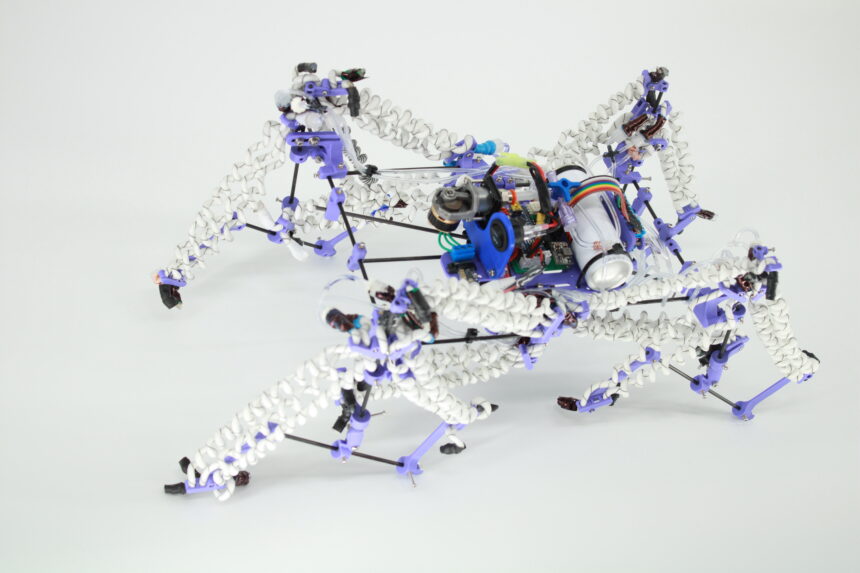
Newswise — A new type of bio-inspired robotic actuator is the foundation for lighter-weight robots that won’t need connection to an external power source, can survive and manipulate objects in boiling water, reach around impediments to retrieve or move materials, and survive an abrasive sanding wheel. And, it can lift up to 100 times its own weight.
Eric Weissman, a doctoral student in Arizona State University’s Robotic Actuators and Dynamics Lab, was the lead author of a paper, Versatile Artificial Muscles by Decoupling Anisotropy, published on March 27. Lab Director Jiefeng Sun, an assistant professor at the School for Engineering of Matter, Transport and Energy, was a co-author.
“Essentially, we developed a novel artificial muscle that mimics real muscles,” explained Weissman. “While bio-inspired muscles previously existed, we have made them more versatile, more lightweight and more powerful.”
Today’s quadruped robots, for example, are significantly limited in mobility because they are usually motor-based and tend to be very heavy and less flexible.
Weissman’s helical anisotropically reinforced polymer (HARP) actuators, on the other hand, mimic natural muscle contraction and expansion. These actuators are flexible, very lightweight, and quiet for use in soft robotics — providing muscle that can lift far more proportionally than electrical-driven counterparts of the same weight.
“These muscles look like little tubes that are coiled like cavatappi, which is a hollow, ridged corkscrew-shaped pasta,” explained Weissman. “When we inflate them by applying a little bit of air, they expand and contract.
“Because of their versatility and adaptability, we were able to reduce that pressure requirement significantly, which enabled us to make a robot that could walk independently without any external power supply, carrying everything it needs on itself.”
The team’s research goes beyond designing bio-inspired muscles for individual, specific tasks. Instead, they have developed a broad framework that enables tailoring the technology for a range of lower-cost applications.
“In disaster response, soft robots will move through debris or collapsed buildings to search for survivors. Their flexible bodies allow them to squeeze into tight places without causing further damage,” Weissman said. “At home, they could safely help older adults with daily activities, like reaching for items on shelves and assisting with simple chores.”
Because HARP actuators can endure high levels of heat, they also can be used for tasks like industrial rinsing processes or marine exploration and sample retrieval near thermal vents where magma-heated water is released into the ocean. Its flexibility and ability to rotate and grasp makes it ideal for agriculture and industrial uses.
Weissman said that he is pursuing robotics because he wanted to grow as an engineer and was intrigued by the notion of robotic soft muscles. “I want do develop bio-designed muscles that bring something of value in the world.”
His five-year plan is to have his own lab and see bio-inspired robotic muscles that are “more affordable accessible in the real world.”
The team has a provisional patent through ASU’s Skysong, and recently was awarded an NVIDIA Academic Grant, which will provide hardware in continued support of the research.
Bionic elephant arm reaches over, around and under to perform industrial tasks
Another project in Sun’s lab is doctoral student Jiahe Wang’s “bionic elephant arm,” a soft robotic arm inspired by the flexibility and dexterity of an elephant trunk. This bio-inspired device enables the arm to reach over, under and around obstacles with ease, making it particularly well suited for inspection and manipulation tasks in industrial settings. Its lightweight structure and inherent compliance reduce the risk of damage to equipment and improve safety for nearby workers, especially in scenarios that require close human-robot interaction.
“This type of soft robotic system enables safer, more adaptable automation. It can interact with equipment without causing damage, and its compliant design reduces the risk of injury to people — even under unexpected contact or failure,” said Wang.
“In places like chemical plants or crowded production lines, equipment is often difficult to reach and sensitive to accidental bumps. As a result, even simple inspections may require stopping operations, leading to costly and time-consuming downtime.
The bionic elephant arm can move around obstacles and reach tight, hard-to-access areas while minimizing the risk of damaging equipment. Its soft, flexible design makes it a strong candidate for inspection and maintenance tasks where safety and accessibility are critical.
In agriculture, a thinner version could move through plants and help with pollination — a job that often requires long hours of manual work. Unlike drones, which create strong air movement that can disturb crops, a soft robot can work more gently. Thicker versions could be used in space, helping astronauts with maintenance or handing them tools. Because the robot is soft and flexible, it is safer to use around both people and delicate equipment, where even small collisions can cause problems.
“Crops like strawberries and tomatoes have dense leaf canopies, which are challenging for pollinators to navigate through,” explained Sun. “A soft robotic arm can get in there and perform the pollination functions, navigating around any obstacles it encounters.”
A new kind of backup
Sun sees endless robotic applications for the bio-inspired muscles, including agriculture, industry, healthcare and surgery, household and landscaping chores and, some day in the not-to-far-distant future, space exploration.
“Ultimately, we can use these softer, flexible and compliant muscle devices in a wide range of robots because they are smaller, more lightweight and don’t present the inherent pinching hazards of today’s rigid robots,” said Sun.
“By using space-grade materials, we can provide mobility, agility and ease of motion in devices designed both for astronauts and the robots they bring with them to space.”
Bringing it all together for the future
Sun sees endless robotic applications for the bio-inspired muscles, including agriculture, industry, healthcare and surgery, household and landscaping chores and, some day in the not-to-far-distant future, space exploration.
“Ultimately, we can use these softer, flexible and compliant muscle devices in a wide range of robots because they are smaller, more lightweight and don’t present the inherent pinching hazards of today’s rigid robots,” said Sun.
“By using space-grade materials, we can provide mobility, agility and ease of motion in devices designed both for astronauts and the robots they bring with them to space.”
Read the original article in ASU News.
Additional robotics articles from Arizona State University:
PhD student goes from ‘hacademic’ to funded founder with cybersecurity solutions
Wil Gibbs spins DARPA competition-winning AI-research into a $1.5 million startup
Digital crimes leave data trails; these students built a tool to help explain them
ASU graduate students build an AI system that translates cyber forensic evidence for judges, juries
Intersection of AI and robotics offers road safety, MedTech
‘Robots don’t have to look like robots’
One researcher’s fix for freights costliest miles
Industrial engineer earns ARPA-I recognition for work developing agentic AI systems to improve freight logistics
Farming robots tackle labor shortages using AI
ASU alum develops smart agriculture that can harvest, wee, spray – and scare birds
AI-guided care spans from space to the Sonoran Desert
A Nasa-backed project is turning smart glasses into emergency medical asstants for both astronauts and Arizonans
Smarter fuel pipelines, safer communities
ASU researchers are using robotics and AI to reimagine infrastructure inspection
https%3A%2F%2Fwww.newswise.com%2Farticles%2Fgiving-robots-more-muscle-can-help-them-lose-weight%2F%3Fsc%3Drsla