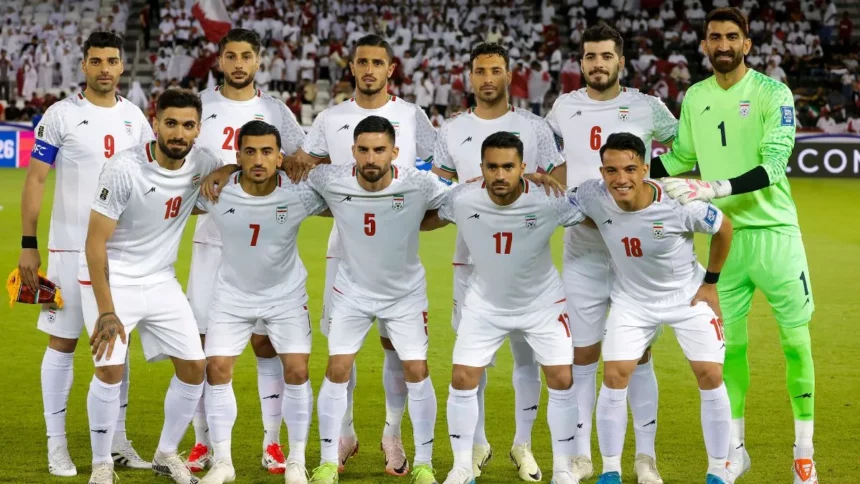
Iran’s participation in the upcoming FIFA World Cup matches scheduled in the United States has come under uncertainty after the president of the country’s football federation admitted he does not know whether the national team will be able to play on American soil. The statement follows escalating hostilities involving the United States and Israel, which have sharply heightened diplomatic tensions.
Iran has been drawn in Group G of the tournament and is slated to play three first-round matches in the United States. The team is scheduled to face New Zealand on June 15 in Inglewood, California, followed by Belgium on June 21 at the same venue. Iran’s final group-stage fixture is set for June 26 in Seattle against Egypt.
However, the Iran World Cup participation in US has been thrown into doubt amid the deteriorating political climate. The federation chief’s remarks reflect uncertainty over logistical clearances, security arrangements, and diplomatic permissions that may be required for the team’s travel and stay in the country.
International sporting events often operate separately from political disputes, but geopolitical crises can complicate travel approvals, visa processes, and security guarantees. With tensions escalating following recent bombardments, concerns have emerged about whether Iranian players, staff, and supporters would face restrictions or operational challenges in the United States.
The potential disruption carries significant implications not only for Iran but also for tournament organisers. Group-stage fixtures involving Iran are scheduled in high-profile venues and are expected to draw global attention. Any alteration to participation could force last-minute scheduling changes or diplomatic negotiations.
Football’s governing bodies typically emphasise that sport should remain independent of politics. However, international relations can influence participation decisions, particularly when state-level conflicts escalate. The Iran World Cup participation in US situation may ultimately depend on diplomatic engagement between the concerned governments and assurances regarding safety and entry procedures.
For now, no official withdrawal or formal restriction has been announced. The uncertainty expressed by Iran’s football federation president underscores how swiftly geopolitical tensions can intersect with global sporting events.
As the World Cup approaches, tournament organisers, national federations, and diplomatic authorities will likely work behind the scenes to ensure clarity. Whether Iran will take the field in California and Seattle as scheduled remains an open question tied closely to broader international developments.