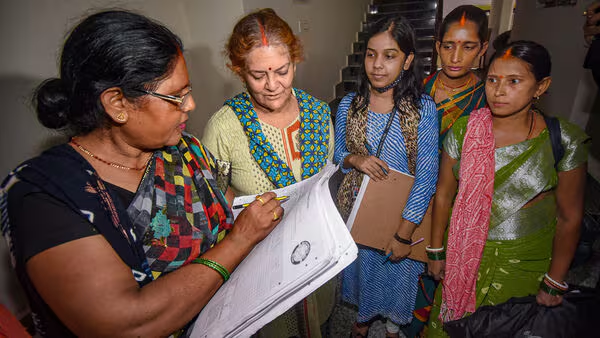
The Government of India has confirmed that the first phase of the country’s 16th Census will begin on April 1, marking the start of a massive nationwide exercise that will continue until September 2026. In a significant move aimed at easing public participation, authorities have clarified that citizens will not be required to submit any documents during the enumeration process.
This announcement comes as part of a broader effort to modernise the census system and encourage greater participation through a simplified and user-friendly approach. The upcoming census will also be India’s first fully digital population count, integrating technology with traditional enumeration methods.
No Documents Required: A Major Relief for Citizens
One of the most important clarifications made by the government is that no supporting documents—such as identity proof, address proof, or income certificates—will be required during the census process. This decision is expected to remove a significant barrier that often discourages participation, especially among marginalised communities.
Instead of relying on documents, the census will be based on self-declared information provided by individuals and households. Enumerators will record responses as shared by residents, ensuring that the process remains simple and inclusive.
This approach also aligns with global best practices, where census exercises typically rely on self-reporting rather than document verification. It helps speed up the process and ensures that people without formal documentation are not excluded.
Officials have emphasised that providing accurate information is the responsibility of citizens, as the data collected will directly influence public policies and development programmes.
Digital Self-Enumeration: A New Feature
For the first time, India’s census will include a self-enumeration option, allowing citizens to submit their details online through an official portal. This digital feature will be available for a limited period before enumerators begin door-to-door visits.
The self-enumeration system is designed to make participation more convenient, particularly for urban residents and those familiar with digital platforms. Once individuals complete the online form, they will receive a reference ID, which can be shared with enumerators during verification visits.
This hybrid model—combining digital submission with physical verification—aims to improve both efficiency and accuracy. It reduces the workload on field staff while ensuring that data is cross-checked and validated.
The government has also ensured that traditional methods will continue alongside digital options, so that people without internet access or digital literacy are not left behind.
Understanding the First Phase: Houselisting and Housing Census
The first phase of the census, known as the Houselisting and Housing Census, focuses on collecting data about households and living conditions rather than individual population details.
During this phase, enumerators will gather information on housing type, amenities, assets, and basic infrastructure. This includes details such as the condition of the house, availability of water and sanitation facilities, and access to electricity.
This phase will be conducted between April and September 2026 across all states and Union Territories, with each region having a specific 30-day window for enumeration.
The information collected during this stage plays a crucial role in planning housing schemes, urban development projects, and welfare programmes.
Second Phase to Focus on Population Data
While the first phase focuses on housing and infrastructure, the second phase—scheduled for early 2027—will involve detailed population enumeration.
In this stage, data will be collected on individual characteristics such as age, gender, education, occupation, and socio-economic status. The reference date for population enumeration is expected to be March 1, 2027.
Together, the two phases provide a comprehensive picture of the country’s demographic and socio-economic landscape.
Largest Administrative Exercise in the World
The census is widely regarded as one of the largest administrative exercises globally, involving millions of enumerators and covering over a billion people.
According to estimates, more than three million officials will be engaged in conducting the census across the country.
The scale of the operation requires meticulous planning, coordination, and public cooperation. From training enumerators to deploying digital tools, the government has undertaken extensive preparations to ensure the smooth execution of the exercise.
The census is conducted under the supervision of the Registrar General of India, which is responsible for designing questionnaires, managing data collection, and publishing results.
Introduction of 33 Questions in First Phase
The government has also finalised a set of 33 questions for the first phase of the census. These questions are designed to capture detailed information about housing conditions and household characteristics.
The questionnaire includes queries related to the type of dwelling, number of rooms, source of drinking water, type of toilet facility, and availability of household assets such as vehicles and electronic devices.
By standardising the questions, the government aims to ensure consistency in data collection across different regions.
The inclusion of detailed housing data is particularly important for identifying gaps in infrastructure and planning targeted interventions.
Emphasis on Data Accuracy and Confidentiality
The government has reiterated that all information collected during the census will be kept strictly confidential. The data will be used only for statistical purposes and will not be shared with law enforcement or other agencies.
This assurance is critical in building trust among citizens and encouraging honest responses.
Officials have also stressed the importance of accuracy in data collection. Since census data forms the basis for policy decisions, even small errors can have significant implications.
To minimise inaccuracies, enumerators will undergo rigorous training and follow standardised procedures during data collection.
Impact on Policy and Governance
The census plays a vital role in shaping public policy and governance. It provides essential data that helps the government allocate resources, design welfare schemes, and plan infrastructure projects.
For example, data on housing conditions can guide urban development initiatives, while information on population demographics can influence education and healthcare policies.
The census also serves as the basis for delimitation of electoral constituencies and allocation of funds to states and local bodies.
Accurate and comprehensive data is therefore crucial for ensuring equitable development and effective governance.
Inclusion and Accessibility Measures
Recognising the diversity of India’s population, the government has taken steps to make the census process more inclusive and accessible.
The digital platform supports multiple languages, allowing citizens to submit their information in their preferred language. This is expected to improve participation rates, especially in regions with linguistic diversity.
Enumerators will also assist individuals who may have difficulty understanding or completing the forms, ensuring that no one is excluded from the process.
Special attention will be given to vulnerable groups, including migrants, homeless individuals, and those living in remote areas.
Challenges and Preparedness
Despite the advancements in technology, the census faces several challenges, including logistical complexities, digital divide, and ensuring data accuracy.
To address these issues, the government has conducted pre-test exercises in selected regions to evaluate the effectiveness of new systems and identify potential problems.
Training programmes for enumerators and awareness campaigns for citizens are also being implemented to ensure smooth execution.
The combination of digital tools and traditional methods is expected to strike a balance between efficiency and inclusivity.
A Digital Leap for India’s Census
The 16th Census marks a significant milestone in India’s journey towards digital governance. The integration of technology into the census process is expected to reduce delays, improve accuracy, and enable faster data processing.
Officials have indicated that a significant portion of the data may be available within the same year, thanks to the use of digital tools.
This represents a major improvement over previous censuses, where data processing often took several years.
The digital approach also allows for real-time monitoring of progress, helping authorities identify and address gaps in coverage.
Public Participation: The Key to Success
The success of the census depends largely on public cooperation. Citizens are encouraged to participate actively and provide accurate information.
Awareness campaigns are being conducted to educate people about the importance of the census and the ease of participation through digital platforms.
By removing the requirement for documents and introducing self-enumeration, the government aims to make the process as accessible as possible.
Looking Ahead
As the first phase of the census begins on April 1, the focus remains on ensuring a smooth and inclusive process. The combination of simplified procedures, digital tools, and extensive preparations is expected to make this one of the most efficient censuses in India’s history.
The data collected will not only provide a snapshot of the country’s current demographic and socio-economic conditions but also serve as a foundation for future development planning.
With no document requirements and multiple participation options, the government has taken significant steps to ensure that every citizen can contribute to this crucial national exercise.