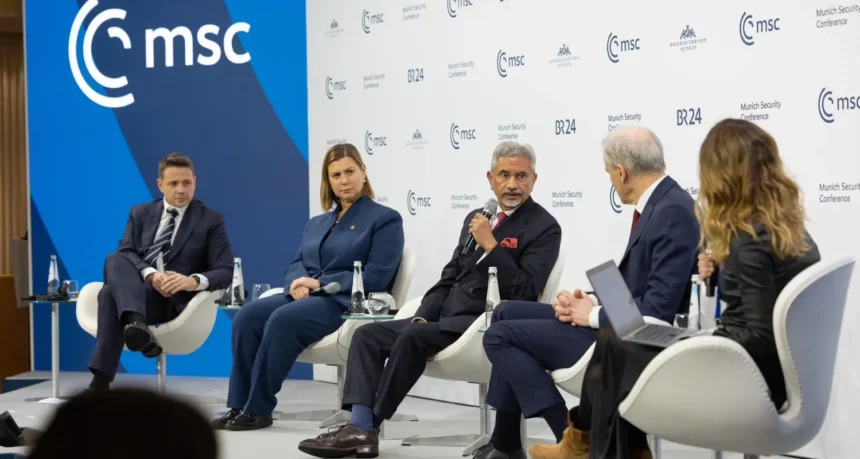
External Affairs Minister S. Jaishankar took a firm stand at the Munich Security Conference, countering claims about democracy’s effectiveness in delivering tangible benefits. Speaking during a panel discussion titled Live to Vote Another Day: Fortifying Democratic Resilience, S. Jaishankar emphasized that democracy is not exclusive to the West and highlighted India’s democratic success. The discussion, which featured Norway’s Prime Minister Jonas Gahr Store, US Senator Elissa Slotkin, and Warsaw Mayor Rafal Trzaskowski, saw S. Jaishankar strongly differ from the narrative that democracy is facing a global crisis.
S. Jaishankar underscored India’s robust democratic framework, pointing out the country’s high voter turnout and efficient electoral process. He referenced the recently conducted elections in Delhi, where he himself cast a vote, displaying the ink mark on his finger as proof. India, he noted, consistently witnesses a voter participation rate of around two-thirds of the electorate. He highlighted that during the last national elections, out of an electorate of approximately 900 million, about 700 million people cast their votes. This, he argued, was a testament to India’s thriving democracy, with votes counted and results declared within a single day. Unlike in some other democracies, S. Jaishankar noted, India’s electoral results are widely accepted without dispute, reinforcing the strength of its democratic system.
Responding to Senator Elissa Slotkin’s remark that “democracy doesn’t put food on the table,” S. Jaishankar firmly countered the assertion, stating that in India, democracy does indeed play a crucial role in ensuring food security. He pointed out that India, as a democratic nation, provides nutrition support and food security to 800 million people, ensuring that democracy is not just a political ideology but a system that actively contributes to the well-being of its citizens. He stressed that different parts of the world experience democracy differently and cautioned against assuming a universal standard for its effectiveness. While some nations may struggle with their democratic structures, he maintained that India has demonstrated how democracy can successfully function even in challenging socio-economic conditions.
Addressing concerns about the Global South’s democratic aspirations, S. Jaishankar asserted that while every large country has unique characteristics, democracy remains a universal aspiration and, in India’s case, a functional reality. He traced India’s democratic foundations back to its independence, explaining that the country naturally adopted a consultative and pluralistic system, which aligned with its societal values.
S. Jaishankar also took a swipe at Western nations, criticizing their inconsistent approach to democracy. He remarked that there was a time when the West treated democracy as an exclusive Western characteristic while simultaneously supporting non-democratic regimes in the Global South. This, he argued, remains a persistent issue, as Western countries continue to practice double standards—preaching democratic values at home while supporting non-democratic entities abroad. He emphasized that the Global South is increasingly observing these contradictions and forming its own conclusions based on the successes and shortcomings of different democratic models.
Despite facing numerous challenges, India has remained steadfast in its commitment to democracy, even during periods of economic hardship. S. Jaishankar pointed out that in South Asia, India stands as one of the few countries that has consistently upheld democratic principles without deviation. He urged the West to acknowledge and learn from successful democratic models outside its own sphere, particularly India’s, if it genuinely wants democracy to flourish on a global scale.
S. Jaishankar’s remarks at the conference served as a powerful assertion of India’s democratic resilience and its ability to navigate complex global narratives. His response to Slotkin and his critique of Western hypocrisy resonated strongly, reinforcing India’s position as a leading democratic force in the Global South.