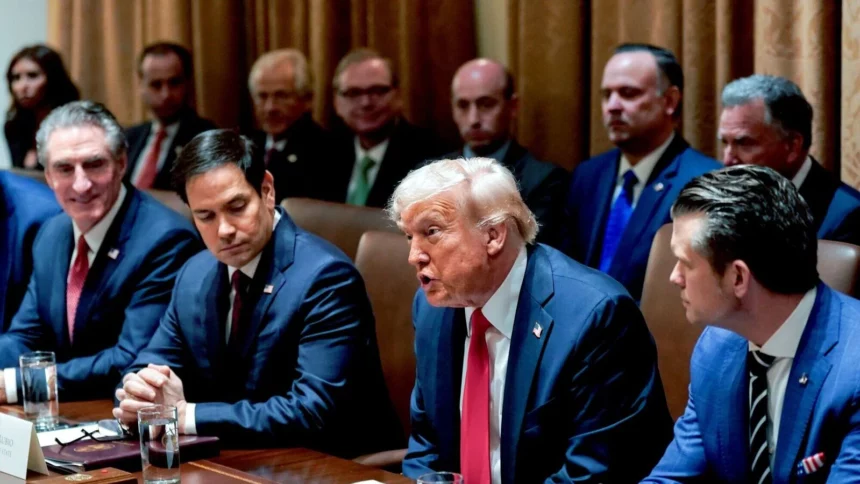
Donald Trump convened the first cabinet meeting of his new term as US president, marking the occasion with a surprising guest. Among the officials seated at the table was Tesla and SpaceX CEO Elon Musk, a key figure in Donald Trump’s administration as co-chair of the newly established Department of Government Efficiency (DOGE). Wearing a “tech support” T-shirt and a “Make America Great Again” campaign hat, Elon Musk stood beside the president, underscoring his new role in the federal government. His presence at the meeting not only signified his increasing influence within the administration but also set the tone for the drastic policy changes being introduced.
Elon Musk, who has been tasked with trimming government expenditures, described himself as “humble tech support” for the federal government. He defended his cost-cutting efforts, warning that without aggressive fiscal discipline, the country could face bankruptcy. Donald Trump echoed Elon Musk’s sentiments, crediting him with uncovering alarming inefficiencies within the government. The president acknowledged that Elon Musk was making significant personal sacrifices by prioritizing his government role over his business empire and emphasized that he had been under considerable scrutiny for his involvement in the administration.
Despite Elon Musk’s confidence in his team’s financial restructuring efforts, he admitted that mistakes had been made. One such instance involved the accidental cancellation of the Ebola prevention grant due to sweeping budget reductions at the US Agency for International Development (USAID). Elon Musk acknowledged the error but assured that funding was promptly restored once the oversight was realized. He emphasized that such missteps were an unavoidable aspect of aggressive cost-cutting initiatives.
Meanwhile, the Donald Trump administration continued its push for mass layoffs in federal agencies. Agencies were instructed to submit workforce reduction plans by March 13, with a focus on significantly downsizing government operations. Environmental Protection Agency (EPA) administrator Lee Zeldin announced plans to cut up to 65% of the EPA’s 15,000 employees. Reports indicated that agencies like the US Fish and Wildlife Service and the Bureau of Indian Affairs could face workforce reductions of up to 40%. Elon Musk projected that his efficiency team could trim at least $1 trillion from the $6.7 trillion federal budget this year alone, reinforcing Donald Trump’s commitment to downsizing government operations.
One of the most controversial aspects of Elon Musk’s role in government oversight was his demand for weekly work reports from federal employees. Last week, Elon Musk announced that all federal staff were required to submit a report detailing their weekly achievements in five points. The directive came with a strict deadline, with non-compliance resulting in immediate termination. The policy sparked significant backlash among federal agencies, leading to internal advisories urging employees not to comply. Facing mounting resistance, the Donald Trump administration initially walked back the deadline but later renewed the ultimatum. Musk defended the initiative, claiming that it was a necessary measure to ensure that government salaries were being paid to actual, living employees. He alleged that several individuals on the government payroll were either deceased or inactive, justifying his request as a basic “pulse check” for the workforce. Donald Trump backed Musk’s demand, expressing dissatisfaction with the non-responsive employees and indicating that their future in government was uncertain.
Amid Elon Musk’s growing influence, Donald Trump introduced a new initiative aimed at generating revenue through the sale of “gold card” visas. The new program, which seeks to replace the long-standing EB-5 investor visa program, offers foreign investors a path to residency in exchange for significant economic contributions to the US economy. Donald Trump projected that selling one million gold card visas could generate up to $5 trillion in revenue, which he claimed would be used to reduce national debt. Commerce Secretary Howard Lutnick criticized the EB-5 program as ineffective and mismanaged, highlighting the gold card initiative as a superior alternative. Donald Trump assured that congressional approval would not be necessary for the program’s implementation and emphasized that the initiative would attract wealthy investors who would contribute substantially to the economy through taxes and job creation.
Trade policies also took center stage in Donald Trump’s cabinet meeting, with the president reaffirming his decision to impose 25% tariffs on Canada and Mexico starting April 2. The tariffs, originally scheduled for March 4, had been delayed following concessions from both countries. Donald Trump reiterated that the tariffs were aimed at pressuring Canada and Mexico into tightening border control measures. Commerce Secretary Lutnick clarified that additional reciprocal tariffs could be introduced separately to address concerns over fentanyl trafficking. The move has sparked uncertainty in trade relations, with businesses on both sides of the border bracing for potential disruptions.
On the foreign policy front, Donald Trump announced that Ukrainian President Volodymyr Zelenskyy would visit Washington on Friday to finalize a minerals agreement. Donald Trump described the deal as significant but refrained from committing to any security guarantees for Ukraine. Zelenskyy acknowledged that the agreement’s success would depend on Donald Trump’s approach, while Trump dismissed the idea of extending US security commitments to Ukraine, instead emphasizing that European nations should take the lead in providing security assurances. Donald Trump welcomed UK and French discussions on deploying peacekeeping forces but made it clear that the US would not be responsible for safeguarding Ukraine’s security. He asserted that the presence of US personnel on the ground would naturally serve as a deterrent, reducing the likelihood of further aggression.
Donald Trump’s stance on Ukraine took a more definitive turn as he ruled out Kyiv’s potential NATO membership. He suggested that Ukraine’s NATO ambitions had contributed to the outbreak of war, blaming the alliance for exacerbating tensions. His remarks followed the US’s recent vote aligning with Russia at the United Nations in calling for an end to the conflict. While Donald Trump claimed that his administration was working toward a balanced resolution, he maintained that Russia’s President Vladimir Putin would have to make concessions for peace negotiations to progress. Despite his professed role as a peacemaker, Trump also reiterated that the decision to implement a ceasefire with Hamas rested solely with Israel. His comments highlighted a shifting US foreign policy approach, positioning his administration as a mediator while distancing itself from long-standing alliances and commitments.
Donald Trump’s unconventional approach to governance, combined with Elon Musk’s growing influence in federal operations, has set the stage for a dramatic transformation of US domestic and international policies. From aggressive cost-cutting measures and mass layoffs to sweeping changes in immigration and trade policies, the new administration is rapidly reshaping the country’s political and economic landscape. The evolving dynamics between Donald Trump and Elon Musk are likely to play a crucial role in determining the administration’s direction, with both figures pushing for an unprecedented restructuring of government operations.