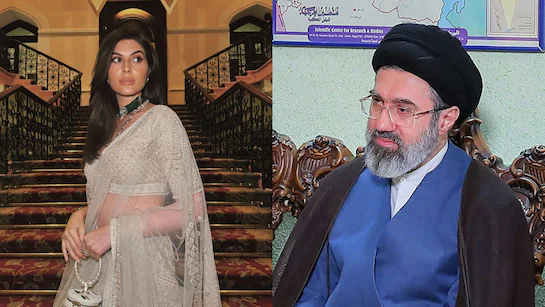
Actress Elnaaz Norouzi, known for her role in the popular series Sacred Games, has spoken strongly against recent political developments in Iran, criticizing the reported appointment of Mojtaba Khamenei as the country’s new Supreme Leader. In a series of statements, the Iranian-origin actress expressed deep concern about Iran’s political future and questioned how Mojtaba Khamenei was chosen for the position. She also reflected on her personal experiences growing up in Iran and spoke about the challenges faced by ordinary citizens in the country. At the same time, Norouzi emphasized her emotional connection with India, describing it as her second home where she feels safe and welcomed.
The actress’s comments came shortly after the announcement that Mojtaba Khamenei, the son of former Iranian Supreme Leader Ali Khamenei, had assumed the powerful position of leadership in Iran. The development has generated discussion both inside and outside the country about the political direction Iran may take in the coming years. Norouzi’s reaction reflected strong criticism of the system that allows leadership decisions to be made without what she described as meaningful participation from the public.
According to the actress, the political structure in Iran does not adequately represent the voice of ordinary citizens. She argued that people in the country do not have the freedom to vote or express their opinions openly. Norouzi claimed that those who attempt to protest against government policies often face severe consequences, including imprisonment or violent suppression.
Her remarks quickly attracted attention on social media and in international entertainment and political discussions. Many observers noted that Norouzi, who has built a successful acting career outside Iran, has frequently used her platform to speak about social and political issues affecting Iranian society.
While discussing the leadership change, Norouzi questioned the legitimacy of the process through which Mojtaba Khamenei was reportedly selected. She asked who ultimately decided that he should become the Supreme Leader and suggested that such a critical decision should involve the participation and approval of the Iranian people.
The actress has previously expressed strong views about Iran’s political leadership. Earlier, she publicly supported the end of the rule of former Supreme Leader Ali Khamenei, arguing that the country needed fundamental political reform. Her recent comments continue that pattern of outspoken criticism.
Despite the seriousness of her concerns about Iran’s future, Norouzi also spoke warmly about India and its role in her life and career. Having worked in several Indian film and web projects, she described the country as a place where she feels comfortable, respected, and safe. According to her, India has become like a second home, and she hopes to continue working there.
Early experiences in Iran and criticism of the country’s political system
Elnaaz Norouzi was born in Iran but spent much of her childhood outside the country after her family moved to Germany. She later acquired German citizenship and built an international career in modeling and acting. Despite leaving Iran at a young age, she has continued to speak about the experiences that shaped her early understanding of the country’s political environment.
Recalling her childhood, Norouzi shared a memory that she said had a lasting impact on her. She explained that when she was only six years old, she and other students in school were required to chant slogans such as “Death to America” and “Death to Israel.” According to her, the slogans were part of the school environment and reflected how political ideology was embedded in everyday life.
Norouzi suggested that such practices illustrate how the Iranian government attempts to influence public opinion from an early age. She argued that citizens are often expected to conform to official narratives and that questioning authority can be dangerous.
Her criticism extended beyond political messaging in schools to broader issues of civil rights and personal freedom. Norouzi said that ordinary people in Iran face significant restrictions on their rights and freedoms. In her view, the political system does not allow individuals to openly challenge authority or demand change.
She also pointed to the risks faced by those who participate in protests or demonstrations. According to her statements, individuals who publicly oppose the government may be detained, imprisoned, or even subjected to violent crackdowns. These claims echo concerns raised by international human rights organizations about restrictions on political freedoms in Iran.
Norouzi’s willingness to speak openly about these issues reflects a growing trend among members of the Iranian diaspora who use their public platforms to highlight political and social conditions in their homeland. For many artists and activists living abroad, freedom of expression provides an opportunity to discuss topics that may be difficult to address within Iran itself.
At the same time, her comments demonstrate the emotional complexity experienced by individuals who maintain strong cultural ties to their country of birth while living elsewhere. Norouzi has often expressed pride in her Iranian heritage even as she criticizes the country’s political leadership.
Economic concerns, women’s rights and Norouzi’s connection with India
In addition to criticizing Iran’s political leadership, Elnaaz Norouzi also raised concerns about the country’s economic situation. She noted that Iran possesses vast natural resources, including significant oil reserves, yet many citizens continue to face economic hardship.
According to the actress, the value of Iran’s currency has declined dramatically in recent years. She claimed that the currency has lost up to ninety-eight percent of its value, making everyday life increasingly difficult for ordinary people. With wages remaining low while the cost of living rises, many families struggle to maintain financial stability.
Norouzi stated that an average individual in Iran may earn as little as one hundred dollars per month, a figure that she believes is insufficient given the rising cost of basic necessities. She argued that the country’s economic challenges are the result of political decisions and policies that have failed to prioritize the welfare of citizens.
The actress also criticized the government for allegedly directing financial resources toward external political and military activities instead of focusing on domestic development. She claimed that funds are sometimes used to support organizations abroad rather than improving conditions for people within Iran.
Beyond economic concerns, Norouzi highlighted several social issues that she believes require urgent reform. She spoke about the need to end child marriage in Iran and emphasized the importance of expanding rights and opportunities for women.
Among the changes she would like to see are greater access for women to public spaces and professions that have historically been restricted. She specifically mentioned the right of women to attend football matches and the opportunity to become judges within the legal system.
For Norouzi, these reforms represent important steps toward building a more open and inclusive society. She expressed hope that one day Iran would evolve into a country where citizens enjoy greater freedom and equality.
Despite her criticisms of the current political situation, the actress said that she still feels a strong emotional connection to Iran. She explained that if the country were to become free and democratic in the future, she would gladly return to live there and reunite with her extended family.
Until that time, however, Norouzi plans to continue focusing on her career abroad. She expressed particular appreciation for the opportunities she has received in India’s entertainment industry. Her work in Indian films and digital series has introduced her to a large audience and helped establish her reputation as an international performer.
Norouzi gained widespread recognition in India through her role in the acclaimed web series Sacred Games, which became one of the most talked-about streaming shows in the country. Since then, she has appeared in several other projects and has developed a strong fan base among Indian viewers.
She described India as a place where she feels welcomed and secure, both personally and professionally. According to her, the warmth and acceptance she has experienced in the country have made it an important part of her life.
By referring to India as her second home, Norouzi highlighted the sense of belonging she feels within the Indian entertainment community. Her statement also reflects the broader cultural exchange between international artists and India’s rapidly growing film and streaming industries.
Through her comments about Iran’s political future, economic conditions, and social issues, the actress has once again used her voice to engage in discussions that extend far beyond the entertainment world. Her statements combine personal experiences, political criticism, and hopes for reform, offering a perspective shaped by both her Iranian roots and her global career.