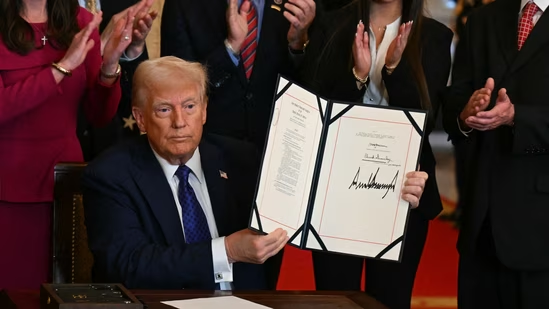
US President Donald Trump on Wednesday signed the Laken Riley Act, the first law of his second administration. The legislation grants federal authorities expanded powers to detain and deport individuals residing illegally in the United States who have been accused of certain crimes, including shoplifting. Donald Trump also announced that his administration is preparing to send the “worst criminal aliens” to the detention center in Guantanamo Bay, Cuba, reinforcing his commitment to aggressive immigration enforcement.
Speaking from the White House after signing the act, Donald Trump hailed it as a landmark law that would safeguard American lives. The act is named after Laken Riley, a 22-year-old Georgia nursing student who was murdered last year by a Venezuelan man who was in the US illegally. Donald Trump, addressing Riley’s family during the signing ceremony, expressed his condolences and stated that the legislation was a tribute to her memory. He described the act as a necessary measure to prevent similar tragedies in the future and reiterated his administration’s pledge to curb illegal immigration and enhance national security.
The act, authored by Republican Representative Mike Collins of Georgia, mandates US Immigration and Customs Enforcement (ICE) to detain illegal immigrants arrested for crimes such as larceny, burglary, shoplifting, theft, or assaulting a police officer. A conviction in court is not required for detention or deportation under the law; mere accusation of these crimes is sufficient grounds for action. Additionally, the law empowers state attorneys general to sue the Department of Homeland Security if they believe their state or its residents are being harmed by federal immigration policies, a provision that may enable conservative state leaders to influence national immigration policy.
During the signing, Donald Trump emphasized the necessity of stricter enforcement, citing the failure of previous federal policies that, in his view, allowed dangerous individuals to remain in the country. He pointed to Riley’s case as an example of systemic lapses in immigration control. Riley’s accused murderer, Jose Antonio Ibarra, had previously been arrested in Texas for illegal entry in 2022 and later released. He was subsequently arrested in New York for child endangerment in 2023 but was again released. In Georgia, he was cited for shoplifting just months before Riley’s murder. Trump argued that had local authorities cooperated with ICE in detaining Ibarra, Riley’s life could have been saved.
Donald Trump also announced new measures to prevent dangerous criminals from re-entering US communities, including the use of Guantanamo Bay as a detention facility. He stated that some criminals posed such a significant threat that their home countries could not be trusted to contain them, prompting his administration to send them to Guantanamo. He directed immigration officials to ensure the facility is prepared to accommodate these detainees, emphasizing that the US has 30,000 beds in Guantanamo dedicated to holding individuals deemed a serious threat to American safety.
Shortly after the signing, the White House confirmed that Donald Trump had signed a memorandum outlining plans for Guantanamo’s use as a detention site for individuals classified as dangerous criminals or difficult to deport. According to reports from the Associated Press, the Donald Trump administration intends to use the facility for individuals whom federal authorities believe pose a significant threat to public safety but are challenging to repatriate due to concerns over their ability to remain detained in their home countries.
The act passed swiftly through the newly Republican-controlled Congress, gaining some Democratic support despite concerns from critics who argue that the legislation could lead to mass detentions for minor offenses like shoplifting. Opponents of the act have expressed fears that it may result in excessive enforcement, leading to unnecessary hardships for immigrants and failing to address the broader complexities of crime and immigration reform. Critics have also accused Donald Trump of leveraging Riley’s tragic death to push through a hardline immigration agenda without addressing comprehensive immigration reform.
Riley’s mother, who attended the ceremony, expressed gratitude toward Donald Trump for fulfilling his promise to tighten immigration policies. She praised the President for keeping her daughter’s memory alive and for taking action to prevent similar incidents. The case has been widely cited by conservative lawmakers as an example of the dangers posed by lax immigration enforcement, further fueling the political debate over border security and immigration policy.
The swift enactment of the Laken Riley Act underscores the priority Donald Trump has placed on immigration control in his second term. With a focus on enhanced border security, mass deportations, and stringent immigration laws, the administration appears determined to reshape America’s immigration landscape. As implementation begins, the law is expected to face both legal challenges and political pushback, but for Donald Trump’s supporters, it marks a strong start to his renewed efforts to fulfill campaign promises on immigration policy.