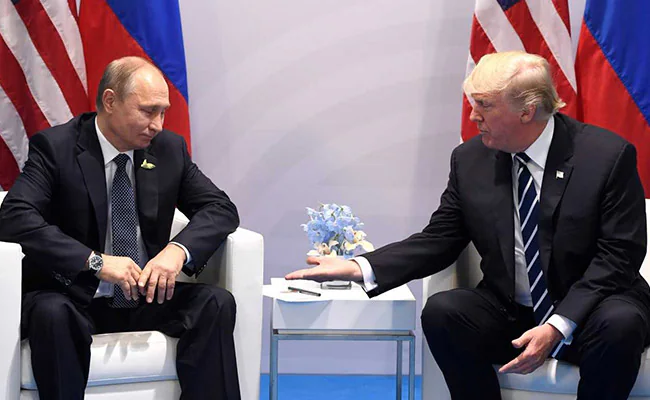
In a significant departure from his usual rhetoric, former US President Donald Trump has strongly criticized Russian President Vladimir Putin, accusing him of “destroying Russia” by refusing to negotiate a peace deal with Ukraine. The remarks, made during a return to the Oval Office, marked an unusually critical tone from Donald Trump, who has expressed admiration for Vladimir Putin in the past.
Donald Trump’s comments come as the ongoing war between Russia and Ukraine, which began with Russia’s invasion of Ukraine in February 2022, has entered its third year with no end in sight. Despite widespread expectations that the conflict would be resolved swiftly, it has turned into a prolonged struggle, leading to significant economic and social turmoil in Russia.
In his remarks, Donald Trump suggested that Vladimir Putin should take the opportunity to reach a deal, emphasizing that continuing the war would only lead to greater challenges for Russia. “He should make a deal. I think he’s destroying Russia by not making a deal,” Trump told reporters. “I think Russia’s going to be in big trouble.”
While Donald Trump has previously shown support for Vladimir Putin, even appearing to accept his word over that of US intelligence during a summit between the two leaders in his first term, his latest statements signaled a shift in his stance. “I got along with him great, I would hope he wants to make a deal,” Donald Trump said. “He can’t be thrilled he’s not doing so well. I mean, he’s grinding it out, but most people thought that war would have been over in about one week, and now you’re into three years, right?”
Donald Trump also highlighted the severe impact the war has had on the Russian economy, with rising inflation and other financial difficulties exacerbating the strain on the nation. According to Donald Trump, the situation is worsening for Vladimir Putin, and the prolonged conflict is hurting Russia in ways that are becoming increasingly difficult to ignore.
Interestingly, Donald Trump also referenced a conversation he had with Ukrainian President Volodymyr Zelensky, who, according to Donald Trump, expressed a desire for a peace agreement to bring an end to the war. This is a notable shift, as Donald Trump has previously been critical of Zelensky, but now he emphasized the Ukrainian leader’s willingness to pursue peace. “Zelensky wants to make a deal,” Donald Trump stated.
During his presidential campaign, Donald Trump repeatedly promised that he would end the war in Ukraine quickly, with his aides suggesting that US foreign aid could be leveraged to pressure Ukraine into making concessions. Donald Trump’s remarks suggest that, if elected again, he would aim to broker a deal that could bring an end to the conflict, although the specifics of how he plans to achieve this remain unclear.
The ongoing war in Ukraine continues to be one of the most significant geopolitical challenges of the 21st century, with both sides suffering heavy casualties and economic losses. The international community remains divided on how best to approach the situation, with some calling for negotiations and others advocating for continued support for Ukraine’s sovereignty.
Donald Trump’s comments on Vladimir Putin and the Ukraine war are likely to have implications for his political future as well, particularly as he continues to position himself as a candidate who could bring stability and resolve to global conflicts. However, his stance on the war and his approach to dealing with foreign leaders like Vladimir Putin could further shape his relationships with both allies and critics on the international stage.
As the war in Ukraine rages on, the question of whether a peace deal is possible remains uncertain. Trump’s call for negotiations and his criticism of Vladimir Putin’s refusal to make peace offer a stark contrast to the more confrontational stance taken by other global leaders. The coming months will reveal whether Vladimir Putin is willing to consider a settlement or if the conflict will continue to escalate, with far-reaching consequences for both Russia and Ukraine, as well as for the broader international community.