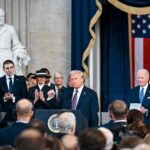
In a moment that caught the attention of the nation and the world, Donald Trump’s second inauguration as President of the United States deviated from tradition in several notable ways. Among the most striking departures from custom was the absence of the President swearing on a Bible, a practice that has been customary for presidents since George Washington took his oath of office. The inauguration ceremony, which was moved indoors due to the extremely cold weather sweeping across much of the United States, was further marked by this unusual break from protocol.
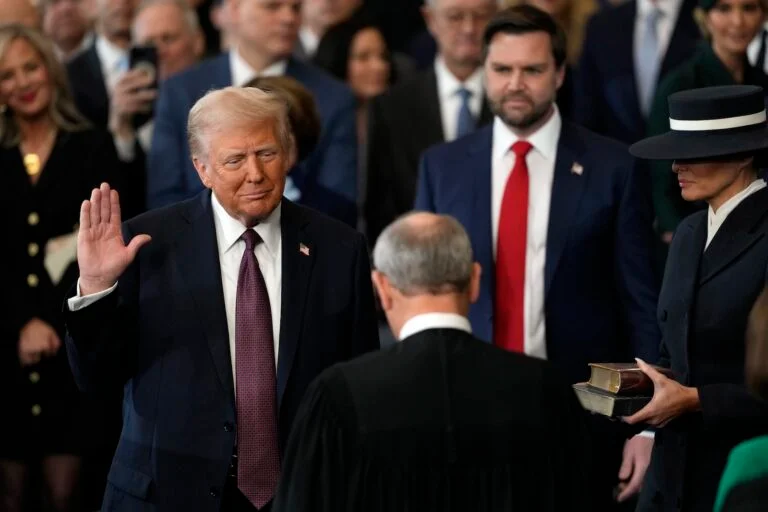
During the swearing-in ceremony, Chief Justice John Roberts, who administered the presidential oath, began reading the words of the oath for Donald Trump to repeat. However, in a moment that many found peculiar, President Donald Trump did not place his hand on the Bible or the U.S. Constitution, which are usually held by the incoming First Lady or a family member during the ceremony. Instead, as Melania Trump, the incoming First Lady, stood beside her husband holding two copies of sacred texts—one a family heirloom given to Donald Trump by his mother and the other the famous Lincoln Bible, used by President Abraham Lincoln in 1861 and by Barack Obama in 2009 and 2013—Donald Trump raised his right hand but allowed his left hand to hang by his side.
This deviation from the long-established custom was a moment of intrigue for many onlookers. It remains unclear whether Donald Trump consciously chose to break with tradition or if it was simply an oversight during the busy and solemn occasion. Regardless, it sparked debates across media platforms, with some questioning whether this move was symbolic in any way or merely an accident.
While touching a sacred text is not a legal requirement during the presidential oath, as the U.S. Constitution merely demands that presidents declare their loyalty “by oath or affirmation,” the act of swearing on a Bible has long been a symbolic tradition. The Constitution itself stipulates that no religious test should ever be required for public office, and the failure to touch the Bible was not a violation of any legal or constitutional obligation.
In addition to the symbolic gesture of not swearing on the Bible, Donald Trump’s second inauguration was also noteworthy for the glaring presence of wealth and corporate power. The event saw an unusual number of tech industry moguls and billionaires in attendance, with some onlookers remarking that the combined wealth of the business leaders present at the ceremony could exceed $1 trillion—the approximate Gross Domestic Product (GDP) of Switzerland. Among those in attendance were Jeff Bezos, CEO of Amazon; Mark Zuckerberg, founder of Meta (formerly Facebook); Sundar Pichai, CEO of Google; Tim Cook, CEO of Apple; and Elon Musk, CEO of Tesla and the world’s richest person. The presence of these tech giants raised eyebrows and sparked discussions about the growing convergence of money, politics, and power in Washington, with many viewing their attendance as a reflection of the strong ties between Silicon Valley and the nation’s political elite.
In the aftermath of the inauguration, the unusual break from tradition regarding the Bible during the presidential oath continued to stir conversations about the symbolic nature of the event and what it may signify about Donald Trump’s relationship with religion and tradition. For many, it was another instance of Donald Trump’s willingness to defy norms and embrace a more unconventional approach to the presidency. Whether intentional or not, his choice to not swear on the Bible provided another memorable moment in a ceremony that was already filled with its own set of dramatic moments and departures from previous norms.
Despite the controversy over the Bible and other aspects of the event, Donald Trump’s second inauguration was marked by his continued promise to address the pressing issues of the country, including the economy, national security, and social policies. While his swearing-in ceremony may have broken with tradition, his presidency, as he affirmed during the event, was committed to pushing forward with bold actions and policies that would continue to shape the future of America.
As the nation watched this significant event unfold, it became clear that Donald Trump’s second term would not be constrained by tradition, and his leadership would continue to provoke debate and scrutiny both at home and abroad.