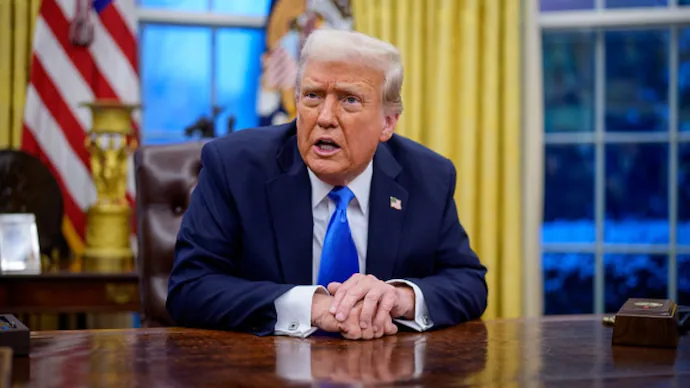
The administration of former U.S. President Donald Trump has initiated a sweeping overhaul of the U.S. Agency for International Development (USAID), effectively sidelining the majority of its workforce and taking steps to dismantle the agency, which has long been a cornerstone of American humanitarian assistance abroad. The drastic move, announced in a notice on the agency’s website, will see nearly all USAID employees either fired or placed on administrative leave, leaving only a select group of personnel responsible for mission-critical functions, core leadership, and specially designated programs.
According to the notice, all affected employees will be placed on leave globally starting at 11:59 p.m. EST on Sunday, with an estimated 1,600 U.S.-based workers expected to lose their jobs in the process. An earlier communication had indicated that up to 2,000 positions would be eliminated, but no clarification has been provided regarding the discrepancy in numbers. USAID has stated that individuals impacted by these terminations will receive official notifications on February 23, 2025, along with details about their benefits and rights. Meanwhile, those deemed essential to operations will be informed of their continued employment status by 5 p.m. EST the same day.
The Donald Trump administration’s actions come just days after a U.S. judge granted legal clearance for the White House to proceed with its plans to withdraw thousands of USAID personnel from overseas posts within 30 days. The agency has assured affected overseas staff that a voluntary, agency-funded return travel program will be available, along with certain unspecified benefits. The notice further states that personnel will retain access to agency systems, diplomatic channels, and other resources until they return home. Additionally, USAID has pledged to provide guidance in the coming week on how employees can retrieve personal belongings from their former workspaces and return government-issued equipment.
The sweeping overhaul of USAID has been led by tech billionaire Elon Musk, who heads the Donald Trump administration’s newly created Department of Government Efficiency. Musk, who has repeatedly criticized USAID as a “criminal organization” and a “viper’s nest of radical-left Marxists who hate America,” has been a vocal proponent of dismantling what he and other Donald Trump allies describe as a bloated agency plagued by waste, fraud, and ideological bias. They argue that USAID’s operations have strayed far from their intended mission and instead serve as a tool to advance liberal internationalist policies that do not align with U.S. national interests.
Former USAID officials and international humanitarian organizations have condemned the administration’s decision, warning that it could have catastrophic consequences for vulnerable populations worldwide and significantly weaken U.S. soft power on the global stage. Critics argue that the agency plays an indispensable role in responding to humanitarian crises, stabilizing displaced populations, and containing disease outbreaks. Marcia Wong, a former deputy assistant administrator for USAID’s Bureau for Humanitarian Assistance, called the move “a shortsighted, high-risk, and frankly, stupid act” that would leave millions of people without vital aid and support.
The agency, established in 1961 by former U.S. President John F. Kennedy, has long been recognized as the largest single donor of humanitarian assistance in the world. In 2023 alone, USAID was responsible for disbursing more than half of Washington’s $72 billion foreign aid budget, funding projects ranging from disaster relief and healthcare initiatives to infrastructure development and democratic governance programs. The dismantling of USAID marks one of the most aggressive efforts yet by the Donald Trump administration to reshape America’s foreign policy apparatus and withdraw from international engagement.
Despite the administration’s claims that USAID has become inefficient and ideologically driven, critics argue that the move is driven more by political ideology than by genuine concerns over waste or mismanagement. Many foreign policy analysts fear that weakening or eliminating USAID will not only damage America’s reputation as a global leader in humanitarian aid but will also create a power vacuum that rivals such as China and Russia could exploit. With international crises on the rise, from conflicts in the Middle East to climate-related disasters in Africa and Asia, the decision to gut USAID comes at a time when global humanitarian needs are greater than ever.
The move has already sparked significant backlash from lawmakers, with members of both parties questioning the wisdom of effectively dismantling an agency that has been central to U.S. foreign assistance for over six decades. The fate of USAID remains uncertain, but the sweeping staff reductions signal that the Donald Trump administration is committed to fundamentally reshaping America’s approach to international aid. As the global community watches closely, the long-term implications of this decision will likely be felt far beyond Washington, affecting millions who depend on U.S. humanitarian assistance for survival.