FOR IMMEDIATE RELEASE
Newswise — Results of the DYNAMIC-III trial, a multi-institutional phase II/III international study conducted at Johns Hopkins and about 20 sites in Australia and Canada, showed that by using ctDNA to guide treatment, patients who tested negative for ctDNA following surgery received less chemotherapy and had fewer hospitalizations and treatment side effects. The study was published Oct. 20 in Nature Medicine and presented at the European Society for Medical Oncology meeting in Berlin, Germany. The work was partly supported by the National Institutes of Health.
Current treatment for Stage 3 colon cancer — defined as cancer that has spread beyond the lining of the colon to nearby lymph nodes — lacks personalization, the authors wrote. The standard of care for patients with Stage 3 colon cancer is chemotherapy after surgery, usually with two agents: a fluoropyrimidine, such as 5FU, plus oxaliplatin, explains study co-author Yuxuan Wang, M.D., Ph.D., an assistant professor of oncology at Johns Hopkins. “It’s a pretty toxic regimen, especially the oxaliplatin part, which can lead to long-term neuropathy (numbness),” she says. “It’s a tough regimen to be on for months at a time.”
“ctDNA is a very strong prognostic marker for patients with Stage 3 colon cancer in terms of predicting relapse-free survival as well as response to chemotherapy,” Wang says. Using it to guide therapy could mean that postsurgical chemotherapy could be escalated or de-escalated depending on ctDNA status.
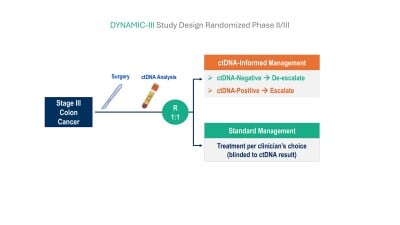
In the study, 1,002 patients with Stage 3 colon cancer underwent ctDNA testing five to six weeks following surgery and were randomly assigned to receive either standard care or care guided by results of the ctDNA testing. Of these patients, 500 were assigned to standard management and 502 were assigned to ctDNA-guided care.
In the ctDNA-guided arm, patients who tested positive for ctDNA received escalated therapy. Half received a combination of three chemotherapy drugs called FOLFOXIRI, and 43% received six months of oxaliplatin-based doublet chemotherapy. Those who tested negative for ctDNA received treatment de-escalation, reducing the frequency and/or duration of oxaliplatin-based chemotherapy. The study looked for recurrence-free survival three years after surgery for patients in the ctDNA-negative arm versus two years after surgery for patients in the ctDNA-positive arm.
At an average follow-up of 47 months, people who tested negative for ctDNA experienced significantly fewer recurrences compared with those who tested positive for ctDNA. Forty-nine percent of those who were ctDNA-negative had a recurrence, compared with 87% who were ctDNA-positive, as of three years following surgery.
In ctDNA-negative patients, giving less chemotherapy resulted in less oxaliplatin use (34.8% vs 88.6%), fewer hospitalizations (8.5% vs. 13.2%), and fewer high-grade adverse events (6.2% vs. 10.6%) using ctDNA-guided therapy instead of standard management. The recurrence rates in patients who were de-escalated was comparable though slightly higher than those undergoing standard management (three-year recurrence-free survival of 85.3% vs 88.1%). However, for patients who were ctDNA-positive, increasing therapy did not necessarily improve outcomes over standard management, as measured by recurrence-free survival at two years, which was 51% for those receiving escalated therapy vs. 61% for those receiving standard of care, suggesting a need for novel strategies for ctDNA-positive disease, authors noted.
Persistent ctDNA after treatment predicted a markedly worse prognosis, with an average three-year recurrence-free survival of just 14%, versus 79% for those who cleared their ctDNA with chemotherapy.
Among 702 ctDNA-negative patients, 95 (13.5%) had a recurrence, with a predominance of recurrences in the lungs (39%) and peritoneum (34%), a layer of tissue lining the abdomen. These sites shed less ctDNA.
“This study clearly shows the value of measuring tumor-specific genetic alterations in the blood of patients, informing their management and improving the lives of patients who don’t need aggressive therapy,” says study co-author Bert Vogelstein, M.D., Clayton Professor of Oncology at the Johns Hopkins University School of Medicine, co-director of the Ludwig Center at Johns Hopkins and a Howard Hughes Medical Institute investigator. Vogelstein and colleagues were the first to show that colon cancer is caused by a sequence of genetic mutations and showed that DNA shed from tumors could be detected in blood, stool and other body fluids.
In a prior study, researchers demonstrated that ctDNA could be used to identify patients with Stage 2 colon cancer who could most benefit from chemotherapy following surgery. Using ctDNA in this manner to stratify treatments among patients is part of a movement toward precision medicine — individualized care that tailors therapies to the unique characteristics of a cancer.
“This study demonstrates that likely, in the near future, ctDNA can be used to help make clinical decisions for patients with colon cancers,” says Wang. “Conceivably, we can use ctDNA in other tumor types to inform patient management the same way.”
The study was supported by the Australian National Health and Medical Research Council, the Marcus Foundation, the Virginia and D.K. Ludwig Fund for Cancer Research, the Lustgarten Foundation, The Sol Goldman Charitable Trust, the National Institutes of Health (grant s CA62924, CA009071, GM136577 and CA06973), the Epworth Medical Foundation and the Eastern Health Research Foundation. In Canada, the study was supported by a project grant from the Canadian Institutes of Health Research and operational support to the Canadian Cancer Trials Groups provided by the Canadian Cancer Society.
Study co-authors were Joshua D. Cohen, Janine Ptak, Natalis Silliman, Lisa Dobbyn, Maria Popoli, Chetan Bettegowda, Nicholas Papadopoulos and Kenneth W. Kinzler of Johns Hopkins. Investigators from the following institutions contributed to the work: the Peter MacCallum Cancer Centre, Melbourne, Australia; the Walter and Eliza Hall Institute of Medical Research, Melbourne, Australia; the University of Melbourne, Australia; BC Cancer, Vancouver, Canada; the Canadian Cancer Trials Group, Kingston, Canada; Eastern Health, Melbourne, Australia; Epworth Healthcare, Melbourne, Australia; Monash University, Melbourne, Australia; The Queen Elizabeth and University of Adelaide, Australia; Warringal Private Hospital, Melbourne, Australia; The University of Sydney, Australia; Royal Brisbane and Women’s Hospital, Brisbane, Australia; University of Queensland, Brisbane, Australia; Bendigo Health, Bendigo, Australia; Newcastle Private Hospital, Newcastle, Australia; Northern Health, Melbourne, Australia; Western Health, Melbourne, Australia; Verspeeten Family Cancer Centre, London, Canada; Wollongong Hospital, Wollongong, Australia; Macarthur Cancer Therapy Centre, Campbelltown, Australia; and Howard Hughes Medical Institute, Baltimore.
Wang is a consultant to Belay Diagnostics and Haystack Oncology. Vogelstein and Kinzler are founders of Exact Sciences. Vogelstein, Kinzler and Papadopoulos are advisers to and hold equity in Exact Sciences. They also are founders of and own equity in Clasp Therapeutics and Haystack Oncology, a Quest Diagnostics company; and are consultants to and hold equity in CAGE Pharma. Vogelstein is a consultant to and holds equity in Catalio Capital Management. Bettegowda is a consultant to Depuy-Synthes, Bionaut Labs, Haystack Oncology and Galectin Therapeutics. He also is a co-founder of OrisDx and Belay Diagnostics. Popoli is a consultant to Haystack Oncology. Dobbyn is an employee of Haystack Oncology. The terms of all of these arrangements are managed by The Johns Hopkins University in accordance with its conflict-of-interest policies.
https%3A%2F%2Fwww.newswise.com%2Farticles%2Fdna-shed-by-colon-cancers-may-help-personalize-postsurgical-treatment%2F%3Fsc%3Drsla