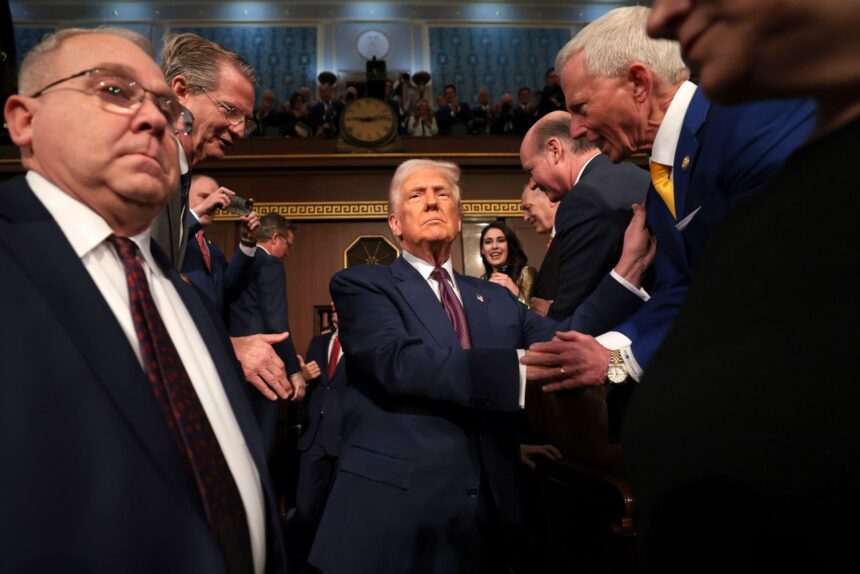
United States President Donald Trump’s joint address to Congress on February 25 was a reflection of both his vision for the country’s future and the deep partisan divisions that continue to define American politics. His over 90-minute speech, one of the longest delivered in decades, underscored two key themes—his administration’s commitment to restoring America’s “greatness” and the growing polarization between Democratic Party and Republican Party lawmakers. The impact of this address is set to unfold in the coming weeks as legislative battles over key policies, including tax reforms, border security, and economic measures, begin to take shape.
Amid sharp political divisions, Democratic Party leadership had urged its members to maintain composure and avoid giving the Republican Party an opportunity to control the narrative. However, this proved difficult, as many Democratic Party lawmakers openly protested Donald Trump’s policy proposals. Signs reading “Save Medicaid,” “Protect Veterans,” and “Lies” were displayed in response to budgetary allocations that Donald Trump claimed were misused under the previous administration. Tensions escalated further when senior Democratic Party Congressman Al Green of Texas, who had previously moved an impeachment motion against Donald Trump, was escorted out of the House for interrupting the speech.
Donald Trump, in his address, sought to build momentum for his legislative priorities, including tax cuts on interest for American-made cars, eliminating taxes on tips, overtime pay, and social security benefits. In a moment of direct confrontation with Democratic Party members, he pointed towards them, sarcastically stating that they should support the tax cuts, suggesting that failing to do so would harm their electoral prospects. His remark, “I am doing you a big favor by telling you that,” drew immediate reactions from Democratic Party members.
Despite controlling both the House and the Senate, the Republican Party faces internal challenges in pushing through Donald Trump’s legislative agenda. Just days before the speech, the House narrowly voted 217-215 to advance a Republican-backed plan. The vote came after an all-day effort to convince reluctant Republican Party lawmakers to support the measure. Speaker of the House Mike Johnson had to delay and restart voting after initial resistance from a faction of conservative Republican Party members who believed the plan did not sufficiently address deficit reduction. This internal division highlights the difficulty of enacting Donald Trump’s policies, even with a Republican Party majority.
Another contentious issue arose when Donald Trump suggested scrapping the CHIPS and Science Act, a bipartisan bill passed in 2022 that allocated $52 billion for domestic semiconductor manufacturing. A section of Republican Party lawmakers opposed this idea, fearing economic consequences. Meanwhile, Democratic Party lawmakers remain determined to resist Donald Trump’s initiatives, particularly those aimed at reversing policies implemented during President Joe Biden’s tenure.
The widening divide between the two parties reflects the deep political polarization that took root during Donald Trump’s first term and has now intensified. With moderates on both sides finding little room for compromise, the legislative landscape remains fraught with challenges. The months ahead will be a crucial test for Donald Trump’s administration as it navigates these internal divisions while attempting to push forward its ambitious policy agenda.