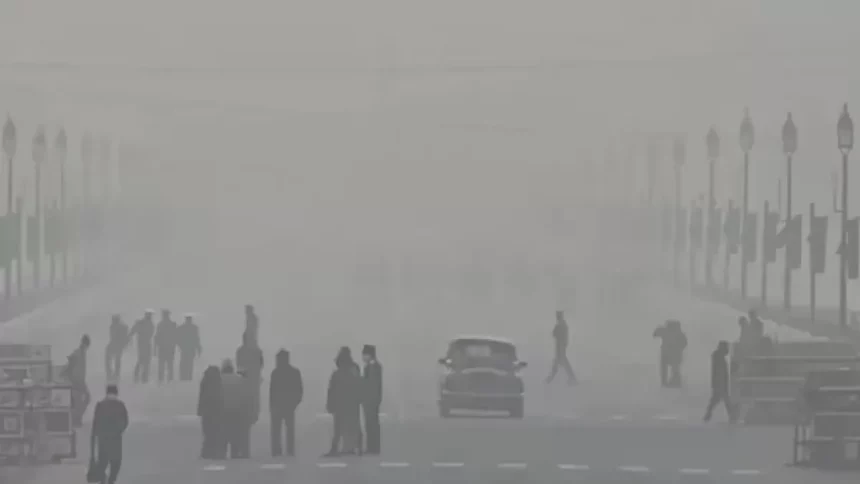
North India continues to grapple with dense fog for the second consecutive day, severely impacting visibility, dropping temperatures, and causing significant disruptions to train and flight operations across several states. The blanket of fog has brought travel chaos and discomfort to passengers as airports and railway stations report widespread delays and cancellations.
At Delhi’s Indira Gandhi International Airport, over 170 flights were delayed, and 38 were cancelled by Saturday morning. The Delhi airport issued an advisory urging passengers to check with their respective airlines for updates as operations remained hampered by the adverse weather. Several other airports, including Srinagar, Chandigarh, Agra, Lucknow, Amritsar, Hindon, and Gwalior, reported zero visibility, adding to the travel woes.
Train operations have also been severely impacted, with over 50 trains running late. Among the worst affected are the New Delhi Vande Bharat Express, which is delayed by over four hours, and the Varanasi Vande Bharat Express, which is running 14 hours late. The Anand Vihar Terminal Superfast Express is delayed by more than seven hours, reflecting the widespread disruption across the railway network.
The India Meteorological Department (IMD) has forecast dense to very dense fog for Delhi and its adjoining areas, extending to Uttar Pradesh, Punjab, and Haryana. Visibility at the Indira Gandhi International Airport in Delhi dropped to zero, according to the IMD. The department has also warned that dense fog is likely to persist in the national capital until January 8, with light rain expected on January 6, which might provide temporary relief.
The ongoing fog has brought challenges for airlines, with IndiGo reporting significant disruptions in its flight schedules due to the reduced visibility. SpiceJet also advised passengers to check their flight statuses, cautioning that bad weather conditions were causing widespread delays and cancellations for both arrivals and departures.
The cold wave gripping the region has exacerbated the situation, with temperatures in Delhi dropping to 10 degrees Celsius as of Saturday morning. According to meteorological standards, a “cold day” is declared when the minimum temperature is below 10 degrees Celsius, and the day’s highest temperature is at least 4.5 degrees lower than the seasonal average.
Air quality has also deteriorated sharply, with the Central Pollution Control Board (CPCB) reporting an Air Quality Index (AQI) of over 240 in Delhi, categorised as ‘Very Unhealthy.’ The poor air quality combined with fog and low temperatures is creating hazardous conditions for residents, prompting health advisories for vulnerable groups, including children and the elderly.
The dense fog has drawn attention to the ongoing challenges faced by transport systems during extreme weather conditions. Authorities continue to monitor the situation, providing updates and advisories to ensure public safety. Passengers across railways and airlines have been urged to remain vigilant and check for updates as the region battles one of its most severe fog spells in recent years.