BYLINE: Chris Patrick
Newswise — NEWPORT NEWS, VA – As an undergraduate student at Tecnológico de Monterrey in Mexico, Felipe Ortega-Gama worked at the U.S. Department of Energy’s Thomas Jefferson National Accelerator Facility as part of the Science Undergraduate Laboratory Internships program. There, Ortega-Gama worked with Raúl Briceño, who was a jointly appointed staff scientist in the lab’s Center for Theoretical and Computational Physics (Theory Center) and professor at Old Dominion University.
Briceño introduced him to quantum chromodynamics (QCD), the theory that describes the strong interaction. This is the force that binds quarks and gluons together to form protons, neutrons and other particles generically called hadrons. Theorists use lattice QCD, a computational method for solving QCD, to make predictions based on this theory. These predictions are then used to help interpret the results of experiments involving hadrons.
“Raúl showed me this plot that had the calculations and the experimental measurements of the mass for a bunch of particles lying on top of each other,” said Ortega-Gama, who was astounded by how well the predictions and measurements lined up. “That was the first time I realized you could use QCD to precisely predict the properties for all these particles.”
This moment drew Ortega-Gama to working with QCD, and to Jefferson Lab. Despite the success shown in the plot, physicists have not yet been able to use QCD to calculate all possible information about quarks, gluons and the particles they make up.
While a Ph.D. student at William & Mary, Ortega-Gama took advantage of the university’s close relationship with the lab and began working with Briceño again, as well as Jozef Dudek, a senior scientist at Jefferson Lab with a joint position at William & Mary, to more intimately understand QCD.
As a result of this collaboration, Ortega-Gama is the lead author of a lattice QCD calculation, published in Physical Review D, that connects two seemingly disparate reactions involving the pion, the lightest particle governed by the strong interaction.
Interconnectedness in QCD calculations
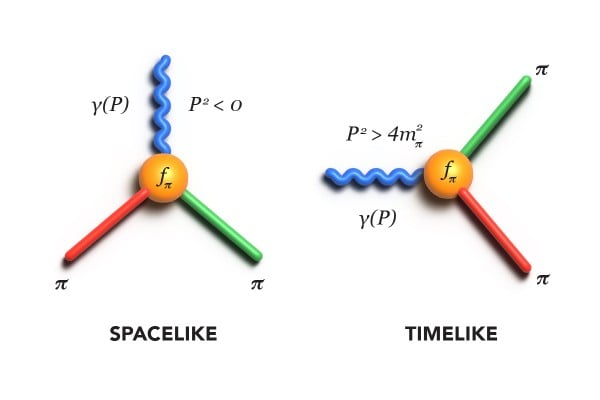
One reaction is known as the spacelike process, where an electron is bounced off a pion. The second reaction, known as the timelike process, is when an electron and antielectron collide, annihilate each other, and produce two pions.
“At face value, these two processes look completely different,” Dudek said. “But in fact, they’re described by the same physics. Their diagrams are just sort of rotated with respect to each other. Felipe has shown, in a single calculation done at the level of quarks and gluons, that they’re connected in a smooth, simple way.”
This numerical calculation is simultaneously able to describe the spacelike and timelike processes, demonstrating the interconnectedness of different reactions described by QCD. While this connection had been observed experimentally, now physicists have the math to corroborate it.
Previous work by Ortega-Gama motivated this inaugural calculation. After particles collide in an experiment, the collision products fly outwards until captured in a detector, travelling a distance vastly farther than the reach of the strong interaction, a ‘theoretical infinity.’ But during numerical calculations, which are limited by available computational power, these particles are placed in a finite box just a few times larger than the range of the strong interaction.
“That’s a problem, because how do you relate the results of a finite box to the infinite volume results measured by your experimental detector?” Ortega-Gama said.
To solve this problem, Briceño, Dudek and other members of the community have developed a formalism – a set of mathematical relations that, once you have the numerical results in hand, will yield the infinite-volume prediction.
Ortega-Gama, alongside Briceño, further developed this formalism to calculate the form factors of other hadrons that, unlike the pion, are unstable under the strong interaction.
“Felipe had some really impressive formalism papers before this paper,” Dudek said. “And the strongest researchers, I would say, in our field of lattice QCD are those who have expertise in both formalisms and actually doing numerical calculations and working with numerical data. This guy can do both of these things at the highest level.”
As his Ph.D. advisor, Dudek met with Ortega-Gama weekly during this project to refine the computations and bounce around ideas.
“For every step of the calculation, I could reach out to him to collaborate so that we could adapt the code to the specific type of study that we were interested in,” Ortega-Gama said.
Interconnectedness in Nuclear Physics
Both Dudek and Briceño are senior members of the Hadron Spectrum (HadSpec) collaboration, which uses lattice QCD to compute the properties of hadrons. Ortega-Gama’s work made use of computational infrastructure the collaboration developed.
“This project evolved from conversations with different members of this collaboration,” Ortega-Gama said.
For example, HadSpec member Robert Edwards, a staff scientist in Jefferson Lab’s Theory Center, has developed a huge set of codes that streamlines lattice QCD calculations. Ortega-Gama leveraged this codebase, as well as Edwards’ expertise, in this work.
Ultimately, these collaborations have led Ortega-Gama to his current position: a postdoctoral scholar at the University of California, Berkeley. He started there in September 2024 to continue working on QCD calculations with Briceño, who is now a professor at UC Berkeley.
“It was definitely helpful to have such an important work to facilitate the transition from a Ph.D. to a postdoctoral scholar,” said Ortega-Gama.
Further Reading
Science Undergraduate Laboratory Internships (SULI) Program
-end-
Jefferson Science Associates, LLC, manages and operates the Thomas Jefferson National Accelerator Facility, or Jefferson Lab, for the U.S. Department of Energy’s Office of Science. JSA is a wholly owned subsidiary of the Southeastern Universities Research Association, Inc. (SURA).
DOE’s Office of Science is the single largest supporter of basic research in the physical sciences in the United States and is working to address some of the most pressing challenges of our time. For more information, visit https://energy.gov/science
https%3A%2F%2Fwww.newswise.com%2Farticles%2Fdemonstrating-the-interconnectedness-in-nuclear-physics%2F%3Fsc%3Drsla