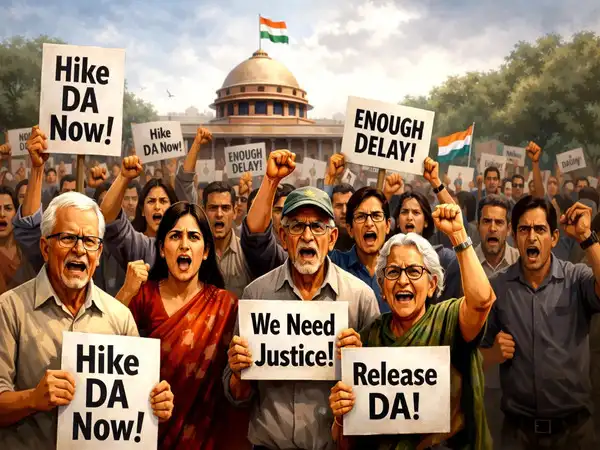
A growing delay in the announcement of the dearness allowance (DA) revision for central government employees has triggered strong dissatisfaction, leading to a planned nationwide protest by employee organisations demanding immediate clearance of pending DA and dearness relief benefits.
The delay in the declaration of the January 2026 dearness allowance hike has intensified concerns among central government employees and pensioners across India. An employee organisation has announced a structured protest across workplaces, citing financial uncertainty and prolonged waiting for inflation-linked salary revision. According to the organisation’s communication to the Cabinet Secretariat, the protest will take place during lunch hours on April 16, 2026, across various government departments. The core demand is the immediate release of the due DA and DR instalments effective from January 1, 2026. The issue has gained traction as the delay is being described as one of the longest in recent years, raising questions over administrative timelines and policy execution. Employees argue that DA is a critical component of salary adjustment against inflation, and any delay directly impacts household financial planning and purchasing power.
Rising Discontent Among Employees Over DA Delay
Central government employees and pensioners have expressed concern that the absence of a timely DA announcement has created financial strain amid rising cost-of-living pressures. DA is typically revised twice a year based on inflation data derived from the Consumer Price Index for Industrial Workers (CPI-IW). The expected hike for January 2026 has not yet been officially declared, even though calculations based on inflation trends suggest a likely increase.
Employee associations argue that previous DA revisions were released without such prolonged gaps, making the current delay unusual. They have also highlighted that arrears from previous revisions were settled, but uncertainty persists regarding the latest installment. The protest plan includes participation from multiple departments such as postal services, income tax, survey organisations, and agricultural units, reflecting widespread dissatisfaction across the administrative system.
Government representatives have not issued a detailed clarification on the timeline, although internal estimates suggest that the revision process is under consideration. The delay has intensified discussions around pay commission expectations and broader salary restructuring for government employees.
Political and Administrative Implications of DA Issue
The DA delay has now evolved beyond an administrative matter into a broader policy concern, with implications for governance credibility and employee relations. Experts note that timely DA revisions are essential for maintaining trust between the government and its workforce, especially during periods of inflationary pressure.
The protest announcement has also brought attention to structural challenges in the DA calculation and approval process, which involves CPI-IW data review and cabinet-level clearance. Employee bodies are demanding a fixed timeline for announcements to avoid recurring uncertainty.
Meanwhile, pensioners have also aligned with employee demands, as dearness relief (DR) is directly linked to DA adjustments. The unified demand reflects a broader concern over income stability for nearly all central government beneficiaries. Analysts suggest that the situation could influence future negotiations related to pay commission reforms and salary structure adjustments.
National Impact and Future Outlook
The upcoming protest is expected to be symbolic but widespread, involving multiple departments simultaneously across India. While it is not expected to disrupt essential services, it highlights growing dissatisfaction within the central government workforce.
If the DA revision is announced soon, the situation may stabilize quickly. However, continued delays could increase pressure on the administration to streamline salary revision mechanisms. The issue also feeds into broader discussions on inflation management and public sector compensation adequacy.
The outcome of this development will likely influence future policy decisions related to salary revisions and employee welfare mechanisms in the central government system.