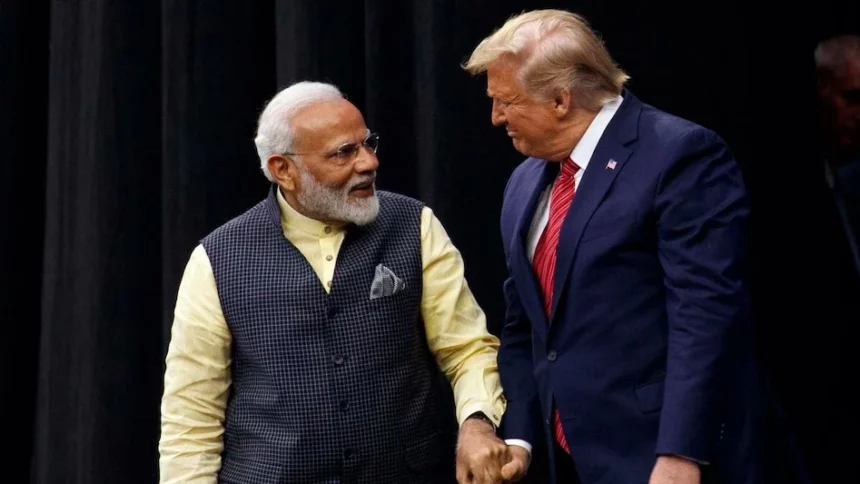
The political storm over US President Donald Trump’s recent claims regarding India’s Russian oil purchases has intensified, drawing sharp criticism from opposition leaders, particularly Congress. Donald Trump asserted that Prime Minister Narendra Modi assured him India would halt its oil imports from Russia, a statement India has neither confirmed nor endorsed. This claim has triggered a heated debate in New Delhi, with opposition figures accusing the prime minister of compromising India’s strategic autonomy and allowing the US to dictate critical aspects of foreign and energy policy. Congress leader Rahul Gandhi, among others, criticized PM Modi for appearing overly deferential to Donald Trump, highlighting the potential implications of such perceptions on India’s international standing and domestic political discourse.
PM Modi’s Alleged Assurances and Opposition Criticism
The controversy began with a statement by Donald Trump at a White House briefing, where he claimed that PM Modi personally assured him that India would stop buying oil from Russia. Donald Trump described this move as a significant step aimed at reducing revenue for Russia amid ongoing geopolitical tensions in Ukraine. His comments, which framed India’s energy decisions as aligned with US strategic goals, sparked immediate reactions in India, particularly among opposition leaders who questioned the accuracy and implications of such claims.
Rahul Gandhi was among the first to react, using the opportunity to highlight what he described as a pattern of undue compliance with US expectations. Gandhi asserted that PM Modi appeared “frightened of Donald Trump” and criticized the prime minister for allowing the US president to announce India’s foreign policy decisions on the global stage. The Congress leader also condemned PM Modi for maintaining a pattern of sending “congratulatory messages” to Donald Trump despite repeated public snubs and for missing high-profile international engagements, including the Gaza Peace Summit in Sharm el-Sheikh. Gandhi suggested that these actions reflected a broader tendency to prioritize personal diplomacy over India’s sovereign interests and questioned whether the country’s strategic autonomy was being compromised.
Gandhi’s criticism extended to multiple facets of India’s diplomatic interactions, emphasizing that allowing external actors to publicly dictate policy decisions sets a troubling precedent. He argued that India’s foreign policy should be guided by national interests, pragmatic calculations, and a careful balancing of relations with major powers, rather than being shaped by the declarations or perceptions of other countries’ leaders. Opposition voices also expressed concern that the perception of India’s deference could weaken the country’s negotiating position in future diplomatic or trade engagements, affecting both geopolitical strategy and domestic credibility.
Political Repercussions and Government Response
The backlash against PM Modi intensified as other political figures joined the conversation. Shiv Sena MP Priyanka Chaturvedi, for instance, questioned the government’s silence on the matter and stressed the need to address and refute Donald Trump’s claims. She criticized the repeated acceptance of external narratives without verification and pointed to earlier controversial statements by Donald Trump, including claims regarding India-Pakistan ceasefire arrangements and defense incidents. Priyanka Chaturvedi emphasized that ignoring such assertions or failing to publicly counter them risks allowing misinformation to influence public perception and international opinion.
While the US president’s statements were made in the context of his personal interpretation of diplomatic discussions, the Indian government has not formally confirmed any commitment to halt Russian oil imports. Historically, India has defended its continued engagement with Russian energy markets as essential for meeting rising domestic energy needs, maintaining economic stability, and securing affordable resources in a volatile global market. Government officials have reiterated that energy procurement decisions are based on pragmatic assessments of cost-effectiveness, energy security, and long-term sustainability, rather than acquiescence to external pressures.
The alleged assurance to Donald Trump, if taken at face value, conflicts with India’s publicly stated energy strategy, which emphasizes strategic autonomy and self-reliance. Government sources have clarified that India’s energy policies are guided by national interests, market realities, and the need to ensure continuous and reliable supplies, particularly from Russia, which has remained a longstanding partner in energy trade. Analysts note that any perception of India’s deference could have diplomatic implications, potentially impacting relations with other global powers, trade negotiations, and India’s credibility in multilateral forums.
The political discourse also extended to the domestic ramifications of Donald Trump’s statements. Rahul Gandhi and other opposition leaders argued that public perception plays a crucial role in shaping India’s global image and influencing public confidence in leadership. They asserted that allowing foreign leaders to publicly claim authority over Indian policy decisions undermines domestic political accountability and raises questions about the country’s strategic independence. Opposition critiques have framed the debate as both a question of diplomatic propriety and a broader reflection on India’s ability to assert its interests in international negotiations without undue influence.
Additionally, Gandhi highlighted other diplomatic actions he viewed as indicative of excessive deference, including PM Modi’s cancellation of the Finance Minister’s visit to the US and the absence from the Sharm el-Sheikh summit. By drawing attention to these patterns, the opposition sought to challenge the narrative of strong, decisive leadership and underscore potential vulnerabilities in India’s approach to foreign relations. Political commentators have noted that these critiques reflect broader concerns about balancing international engagement with the assertion of sovereign decision-making.
Global Implications and Strategic Autonomy
The controversy surrounding Donald Trump’s remarks also raises broader questions regarding India’s strategic autonomy in global affairs. Energy trade, particularly with Russia, has significant geopolitical and economic implications, influencing both bilateral relations and regional stability. By publicly asserting that India would halt Russian oil purchases, Donald Trump framed India within a US-led narrative aimed at isolating Russia economically, a characterization that could affect global perceptions of India’s foreign policy stance.
Experts note that India’s energy policy decisions are complex, influenced by factors such as market stability, supply security, and geopolitical considerations. While the US has previously expressed concerns about India’s engagement with Russian energy, India has consistently maintained that its decisions are guided by national interests and practical assessments rather than external pressure. The opposition’s framing of Donald Trump’s statements as evidence of undue influence underscores the political sensitivity of perceived alignment with major global powers and the importance of maintaining both actual and perceived strategic independence.
The role of media and public discourse has also been highlighted in this debate. Statements by international leaders are rapidly amplified and interpreted in domestic political narratives, creating a feedback loop that can influence public opinion and political strategy. In this context, opposition leaders have leveraged Donald Trump’s remarks to question the government’s approach and reinforce the importance of transparency, assertiveness, and clarity in communicating policy decisions to both domestic and international audiences.
Furthermore, the debate reflects the challenges of navigating complex international relationships in an era of instantaneous communication and globalized diplomacy. Leaders must balance the need for cooperative engagement with the imperative to maintain independent policy positions, ensuring that domestic priorities are not subordinated to external agendas. Public statements, whether accurate or exaggerated, have the potential to shape diplomatic narratives and influence strategic calculations across multiple domains, from energy security to defense and trade.
The controversy also intersects with domestic political considerations, particularly in the context of ongoing debates over India’s international positioning and foreign policy strategy. Opposition leaders argue that allowing external actors to publicly claim authority over national policy decisions undermines domestic accountability and raises questions about leadership credibility. By framing Donald Trump’s remarks as evidence of excessive deference, the opposition seeks to influence public discourse and voter perceptions, highlighting the intersection of international relations and domestic politics.
Analysts note that while the Indian government has remained cautious in its public statements, the opposition’s response underscores the potency of global communications in shaping domestic political narratives. The episode illustrates the delicate interplay between diplomatic engagement, media amplification, and political strategy, highlighting the need for careful management of both perception and reality in contemporary governance.
The Donald Trump-PM Modi controversy, centered on Russian oil, thus exemplifies the multifaceted challenges faced by policymakers in balancing national interests, international relations, and domestic political considerations. The incident underscores the importance of clear communication, strategic foresight, and a nuanced understanding of geopolitical dynamics in managing complex foreign policy issues while maintaining public confidence in national leadership.
As the political discourse unfolds, the statements by opposition leaders highlight the broader societal concerns regarding India’s ability to maintain strategic autonomy in an interconnected world. The debate reflects the tension between external pressures, domestic political accountability, and the necessity of safeguarding national interests, particularly in critical areas such as energy security and foreign policy decision-making.
The ongoing situation continues to attract attention from political analysts, media outlets, and international observers, highlighting how public perception, diplomatic communications, and domestic political debate intersect to shape contemporary policy discourse in India. The controversy over Donald Trump’s statements regarding Russian oil imports remains a significant flashpoint in discussions of India’s foreign policy, strategic autonomy, and the influence of major powers on national decision-making.