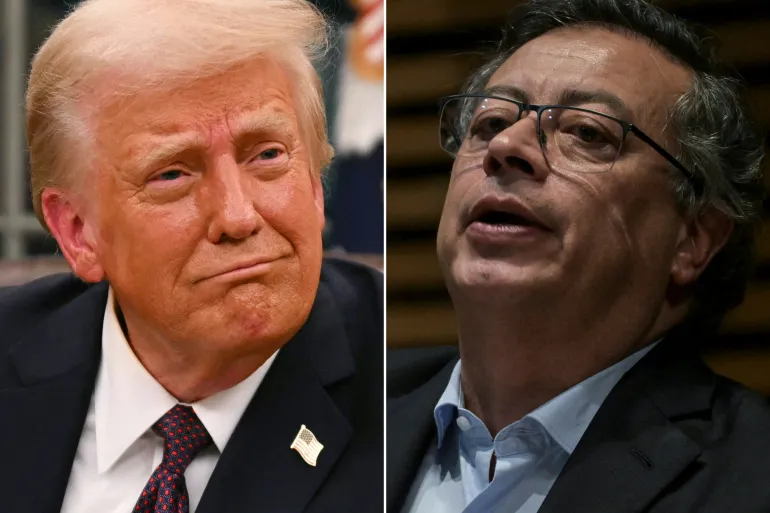
Colombia has reportedly agreed to accept repatriated citizens on U.S. military flights after facing intense pressure from President Donald Trump, who had threatened sweeping sanctions and tariffs. The White House announced the development on Sunday, asserting that the South American nation had backed down following Donald Trump’s warnings. However, there was no immediate confirmation from the Colombian government regarding the claims made by Washington. The agreement, as outlined by the White House, entails Colombia’s “unrestricted acceptance of all illegal aliens from Colombia returned from the United States, including on U.S. military aircraft, without limitation or delay.”
The White House characterized the outcome as a victory for U.S. sovereignty, emphasizing that the administration’s tough stance had reinforced America’s standing on the global stage. “Today’s events make clear to the world that America is respected again,” the White House statement declared. It further underscored that President Donald Trump remains committed to protecting national sovereignty and expects all nations to comply with the repatriation of their citizens who are in the United States illegally. The administration had been locked in a dispute with Colombia after its president, Gustavo Petro, refused to permit the return of deported Colombians on U.S. military planes. Petro, a leftist leader, had earlier signaled willingness to take back migrants but insisted on conditions that preserved their dignity, including their transportation on civilian aircraft rather than military flights.
The standoff had sparked concerns over escalating tensions between the two nations, with Donald Trump warning of significant economic consequences for Colombia. The administration had been considering a range of punitive measures, including the imposition of tariffs and financial sanctions, aimed at pressuring Bogotá into compliance. Colombia, Latin America’s fourth-largest economy, has long maintained strong diplomatic and economic ties with the United States, making any potential economic retaliation from Washington a serious threat to its financial stability.
While the White House framed Colombia’s decision as a diplomatic victory for Donald Trump, the absence of an immediate response from Bogotá left room for speculation about the extent of the agreement and whether it had been reached under duress. The situation underscored the Donald Trump administration’s broader strategy of exerting economic and political pressure on foreign governments to secure compliance with U.S. immigration policies. The White House’s firm stance on repatriations is consistent with Donald Trump’s broader crackdown on illegal immigration, a key pillar of his presidency, which has included measures such as heightened border security, increased deportations, and efforts to pressure foreign governments into accepting deported nationals without conditions.
The dispute over repatriation flights is not an isolated incident but rather part of a larger pattern of strained relations between the Donald Trump administration and leftist leaders in Latin America. Donald Trump has previously clashed with Petro on other issues, including drug policy and economic cooperation. The agreement, if fully implemented as described by the White House, marks a significant concession by Colombia, potentially setting a precedent for other nations resisting U.S. repatriation policies.
Despite the White House’s claims of resolution, the situation remains fluid, with the possibility of further diplomatic back-and-forth between Washington and Bogotá. If Colombia formally confirms the agreement, it could ease tensions in the short term, but the broader debate over immigration enforcement and sovereignty is unlikely to subside. The episode serves as a reminder of the Donald Trump administration’s willingness to leverage economic power to achieve policy objectives, a strategy that has drawn both praise and criticism on the international stage. Whether this move strengthens long-term diplomatic relations between the U.S. and Colombia or leads to further friction remains to be seen.