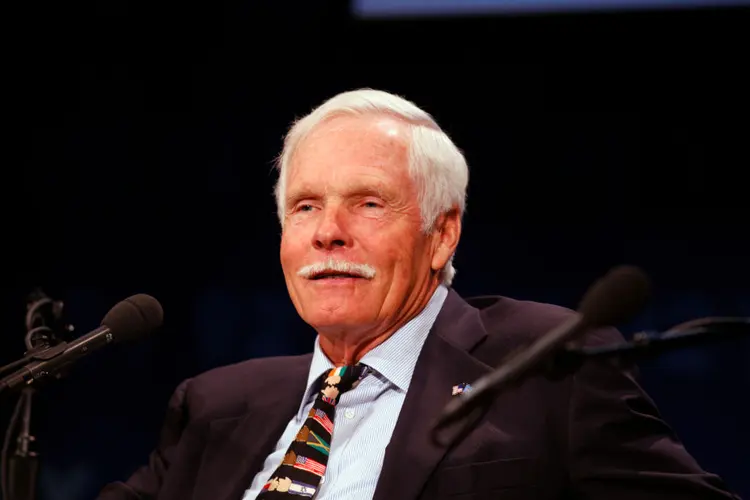
Ted Turner, the pioneering media mogul who founded CNN and transformed global television journalism through the creation of the world’s first 24-hour news network, has died at the age of 87.
Turner passed away peacefully on Wednesday surrounded by family members, according to a statement released by Turner Enterprises. His death marks the end of one of the most influential and revolutionary careers in modern media history.
Widely regarded as one of the architects of contemporary broadcast journalism, Turner fundamentally reshaped how news is consumed worldwide by launching CNN on June 1, 1980. At a time when television news was largely limited to short evening bulletins, Turner envisioned a network delivering real-time reporting around the clock — a concept many critics initially dismissed as impossible.
The Ohio-born businessman eventually built a massive media empire that included cable television’s first superstation, multiple entertainment and movie channels, professional sports franchises and internationally recognised philanthropic initiatives. Known for his outspoken personality and fearless business style, Turner earned the nickname “The Mouth of the South” during his rise as one of America’s most influential media entrepreneurs.
In addition to his media achievements, Turner was also known globally as a philanthropist, environmentalist, sports owner and advocate for nuclear disarmament. He founded the United Nations Foundation, became one of the largest private landowners in the United States and played a major role in the conservation and reintroduction of bison in North America.
Turner is survived by his five children, 14 grandchildren and two great-grandchildren.
Ted Turner Revolutionised Television News With CNN
Turner’s greatest achievement remains the creation of CNN, which permanently altered the structure and speed of television journalism across the world.
Before CNN’s launch, most American television audiences relied on limited evening news broadcasts from traditional networks. Turner believed viewers needed constant access to information rather than waiting for scheduled bulletins.
Explaining his motivation years later, Turner famously said that by the time he returned home from work, the evening news was already over. He believed millions of viewers faced the same problem and saw an opportunity to reinvent television journalism entirely.
Despite having little formal experience in news broadcasting, Turner aggressively pursued his vision. He recruited experienced journalists and executives including Reese Schonfeld, who became CNN’s founding president.
On June 1, 1980, CNN officially went live as the world’s first 24-hour television news channel.
The network initially faced scepticism, technical difficulties and criticism from traditional broadcasters. Some critics mockingly referred to CNN as “Chicken Noodle News” during its early years because of its unconventional format and continuous live coverage.
However, Turner and his team remained convinced they were creating something revolutionary.
CNN’s global breakthrough came during the Gulf War when it became the primary source of live war coverage for viewers worldwide. The network’s real-time reporting from Baghdad fundamentally changed global expectations regarding live television journalism.
The Gulf War demonstrated the power and importance of 24-hour news broadcasting, transforming CNN into an internationally recognised media institution.
Former CNN Worldwide chairman Mark Thompson described Turner as “intrepid, fearless and always willing to back a hunch.” Thompson added that Turner would “always be the presiding spirit of CNN.”
Veteran CNN anchor Wolf Blitzer called Turner “a legend” who revolutionised the television industry by creating the first all-news cable network.
International journalist Christiane Amanpour said Turner inspired journalists globally and encouraged them to strive toward a more informed and hopeful world.
From Billboard Business to Global Media Empire
Turner’s path toward media dominance began after personal tragedy struck his family.
Born Robert Edward Turner III in Cincinnati, Ohio, on November 19, 1938, Turner eventually took over his father’s billboard advertising company following his father’s suicide. Still in his twenties at the time, Turner immersed himself in work and gradually expanded the business into radio and television.
In 1970, he purchased a struggling Atlanta television station known as Channel 17. He later transformed it into WTCG and eventually WTBS, cable television’s first “superstation,” using satellite technology to distribute its signal nationwide.
Turner realised that sports programming could attract major audiences, leading him to acquire broadcasting rights for the Atlanta Braves baseball franchise. He later purchased the Braves outright along with the Atlanta Hawks basketball team.
His success with sports and satellite broadcasting helped finance larger ambitions within cable television.
Over time, Turner expanded his empire further by launching additional networks including CNN2, later renamed HLN, along with TNT, Turner Classic Movies and Cartoon Network.
In the mid-1980s, Turner acquired MGM’s vast film library containing more than 4,000 classic movies. The acquisition generated controversy after Turner began colourising black-and-white films, including the classic movie Casablanca.
Despite criticism from film purists, Turner defended the practice as a way to introduce classic cinema to newer audiences.
In 1996, Turner sold his media empire to Time Warner in a deal valued at approximately $7.5 billion. He later served as vice-chairman of the company before gradually withdrawing from active media management.
Philanthropy, Environmentalism and Global Activism Defined Later Years
Beyond television, Turner became widely respected for his philanthropy and activism.
He established the United Nations Foundation after donating $1 billion to support UN-related humanitarian and development initiatives, one of the largest philanthropic donations in history at the time.
Turner also became deeply involved in environmental conservation. Through extensive land ownership across the United States, he worked to restore ecosystems and reintroduce bison populations across parts of the American West.
His environmental advocacy additionally extended into popular culture through the creation of the animated television series Captain Planet and the Planeteers, designed to educate children about environmental protection and sustainability.
Turner consistently advocated nuclear disarmament and international cooperation throughout his later years, often speaking publicly on issues related to global peace and environmental responsibility.
In 2018, shortly before turning 80, Turner revealed that he had been diagnosed with Lewy body dementia, a degenerative brain disorder affecting cognitive and motor functions.
Earlier in 2025, he was hospitalised with a mild case of pneumonia before later recovering at a rehabilitation facility.
Ted Turner’s Legacy Continues to Shape Global Journalism
Media historians widely regard Ted Turner as one of the most transformative figures in television history. His decision to create CNN permanently altered journalism, politics, war coverage and global information flow.
Before Turner, real-time international news broadcasting barely existed. After CNN’s success, the 24-hour news model spread across the world and became central to modern media ecosystems.
Analysts often compare Turner’s influence on television journalism to the impact of the internet on communication technology. His vision not only changed how audiences consumed information but also accelerated the pace of political reporting, crisis coverage and international awareness.
Former Turner Broadcasting CEO Terry McGuirk once stated that what Turner created was “just as important as the Internet revolution.”
Even decades after stepping away from direct management, Turner continued describing CNN as the “greatest achievement” of his life.
Today, his influence remains visible across every major global news network operating continuous live coverage — a broadcasting model pioneered by his once-radical vision.
As tributes continue pouring in from journalists, political leaders and media organisations worldwide, Ted Turner’s legacy endures not merely as a businessman, but as the man who fundamentally changed the way the world watches history unfold.