China’s stock markets faced continued declines on Friday, marking a shaky start to the new year, despite broader gains in the Asia-Pacific region. Investors were closely examining the latest policy signals from Beijing, which appeared to be having a significant impact on market performance.
The CSI 300 index, which tracks major companies on the mainland, dropped by 0.18% in a volatile trading session, extending the losses seen the day before. In contrast, Hong Kong’s Hang Seng index rose by 1.36%, highlighting a divergence in performance within the region.
Adding to the uncertainty in the markets, China’s bond yields hit record lows. The 10-year government bond yield fell 1.5 basis points to 1.598%, while the 30-year bond yield dropped by 2.9 basis points to 1.819%, according to data from LSEG. These movements reflect investor concerns over the state of the economy and the possibility of further policy changes.
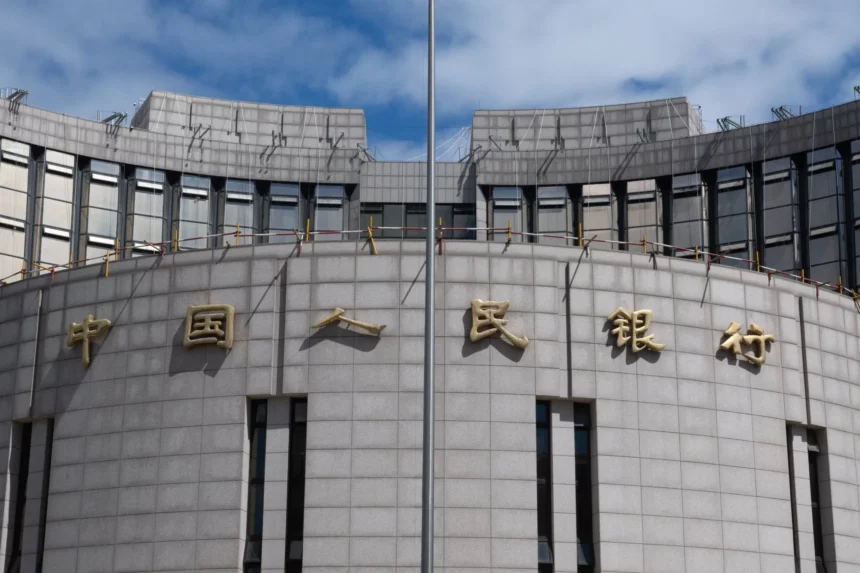
The People’s Bank of China (PBOC) was reported by the Financial Times to be planning interest rate cuts “at an appropriate time” in 2025, potentially as part of efforts to stimulate economic growth. The central bank’s current 7-day reverse repo rate stands at 1.5%. This follows a broader trend of central banks around the world, including the U.S. Federal Reserve, adopting measures to combat inflation and encourage economic recovery.
As part of its efforts to boost consumption, China’s National Development and Reform Commission outlined plans to expand the issuance of ultra-long bonds in the coming year. These bonds are seen as a mechanism to secure long-term funding for the country’s development projects. The commission also emphasized plans to subsidize purchases of consumer goods such as smartphones, smartwatches, and tablets, in addition to providing increased support for vocational training, pensions, and gig economy workers.
Meanwhile, the Chinese Ministry of Commerce made headlines with its proposal to impose export restrictions on certain technology used in the production of battery components and processing critical minerals like lithium and gallium. These moves are seen as part of China’s broader strategy to safeguard its technological advances and maintain control over vital resources.
While investors in China focused on these policy developments, other parts of the Asia-Pacific region displayed varying market performances. In South Korea, despite ongoing political turmoil following the impeachment of President Yoon Suk Yeol, the country’s markets were largely unaffected. The Kospi index gained 2.01%, while the Kosdaq, which tracks smaller companies, rose by 2.30%. South Korean chipmaker SK Hynix also saw a 5.43% increase in its shares, with the company announcing plans to position itself as a “full stack AI memory provider” at the upcoming Consumer Electronics Show 2025.
Meanwhile, Australia’s S&P/ASX 200 index rose 0.72%, and Japan’s markets remained closed due to a national holiday.
In the U.S., major stock indices ended the first trading session of the new year in the red. The Dow Jones Industrial Average fell by 151.95 points, or 0.36%, to close at 42,392.27, while the S&P 500 dropped 0.22% to 5,868.55, and the tech-heavy Nasdaq Composite shed 0.16% to 19,280.79. This marked the fifth consecutive session of losses for both the S&P 500 and Nasdaq, signaling a rough start to the year after the market’s weak finish in 2024.
Tech stocks were among the biggest losers, with Apple falling 2.6% and Tesla declining by 6% due to lower-than-expected annual deliveries. The market’s inability to produce a “Santa Claus Rally” — a historically strong period for stocks that typically occurs in the final days of December and the first few days of January — has left investors with cautious expectations for 2025.
With ongoing uncertainties in both China and the global market, investors are left to assess the potential economic impacts of policy shifts and broader geopolitical tensions. The unfolding situation in the coming weeks will likely provide more clues on the direction of markets as they attempt to recover from the recent declines.