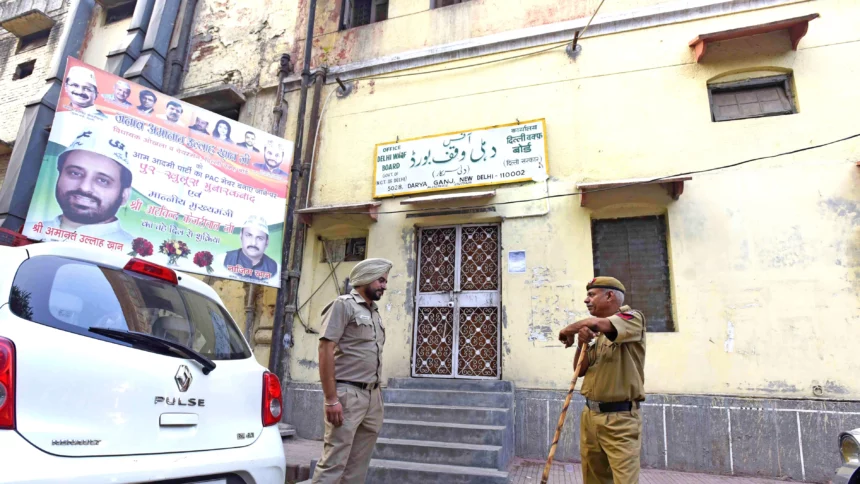
The Narendra Modi government is introducing the Waqf Amendment Law to reclaim government land that has been categorized as Waqf property. This move marks a stark contrast to the policy direction taken by former Prime Minister Indira Gandhi in 1976, who directed state governments to vacate and restore such properties to the Waqf Board. The shift in approach underscores the evolving legal and administrative stance on Waqf properties over the decades.
A letter dated March 26, 1976, written by Indira Gandhi to six chief ministers and the Lieutenant Governor of Delhi, sheds light on the Congress government’s policy at the time. The letter, available on the official website of Waqf under the National WAMSI Project, emphasized the need for urgent resolution of Waqf property disputes. Indira Gandhi pointed out that many Waqf properties had fallen into private or state government possession due to the unsettled conditions following Partition. To avoid prolonged litigation, she urged state governments to settle the matter administratively.
Gandhi proposed three key measures for resolving these disputes. Firstly, wherever feasible, Waqf properties should be vacated and handed over to the Waqf Board. Secondly, in cases where expensive structures had been constructed on such land, the state governments could enter into permanent leases with Waqf Boards after compensating them with the majority of the land’s market value. Thirdly, as an alternative, state governments could pay the Waqf Boards the fair market value of the lands in exchange for a formal relinquishment of rights, provided the relevant Waqf trustees agreed to such a deal.
The letter also indicated that Waqf Boards had provided state governments with lists of properties under government possession, urging them to act accordingly. Gandhi further mandated that a periodic review be conducted and a monthly report be sent to her and the Minister of Waqfs to monitor progress.
Additionally, the letter addressed concerns over Waqf properties being leased at nominal rents due to the Rent Control Acts. Citing recommendations from the Waqf Inquiry Committee, Gandhi advocated for exempting public Waqf properties from these regulations, similar to exemptions granted to charitable trusts and religious endowments. She noted that states such as Andhra Pradesh, Kerala, Karnataka, and Tamil Nadu had already agreed to this exemption and encouraged other states to follow suit.
The letter was addressed to key political figures, including Punjab CM Giani Zail Singh, Haryana CM BD Gupta, Himachal Pradesh CM YS Parmar, Maharashtra CM SB Chavan, Madhya Pradesh CM SC Shukla, Rajasthan CM Harideo Johi, and Delhi’s Lt. Governor Krishan Chand.
The Narendra Modi government’s decision to amend the Waqf law represents a significant departure from past policies, reflecting a broader push to redefine the legal framework surrounding government and religious properties. The move is expected to spark debates on historical precedents, legal rights, and the evolving governance of Waqf assets in India.