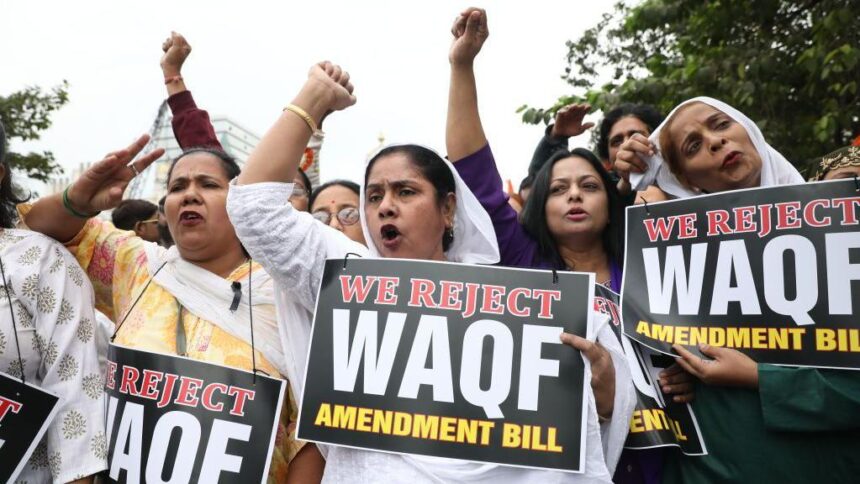
In a significant development, the Centre informed the Supreme Court that it will not implement key provisions of the Waqf (Amendment) Act, 2025 for now, amid growing legal challenges and political criticism. The government also committed to filing a formal response within a week, as the apex court scheduled the next hearing on the matter for May 5.
The Centre’s assurance came during a hearing on a series of petitions challenging the constitutional validity of the new Waqf law. Among the contested provisions are clauses allowing the inclusion of non-Muslims in Waqf Boards and the Central Waqf Council, and the power to de-notify properties previously recognized as Waqf by court declarations. The court, led by Chief Justice Sanjiv Khanna along with Justices PV Sanjay Kumar and KV Viswanathan, recorded Solicitor General Tushar Mehta’s statement that the government would refrain from making appointments to the boards and councils under the new law until further directions.
Political Reactions Emerge
The court also directed that waqf properties already notified, including those recognized by “usage,” would maintain their current status during this period. Petitioners have been given five days to file rejoinders after the Centre submits its response. The matter will next be taken up for interim directions.
The legal battle drew reactions from across the political spectrum. AIMIM MP Asaduddin Owaisi reiterated his opposition to the Act, calling it unconstitutional and vowing to continue his challenge. He welcomed the court’s interim stance on not forming new councils and maintaining existing waqf designations.
AAP leader Amanatullah Khan expressed satisfaction over the government’s assurance, thanking the court for ensuring that waqf-by-user properties would remain untouched. He said the development upholds the integrity of waqf institutions.
Petitions and Constitutional Concerns
Peoples Democratic Party chief Mehbooba Mufti voiced concern over the demolition of religious properties since the law’s passage, urging Prime Minister Narendra Modi to step in. She warned that alienating the Muslim community could destabilize national unity.
The petitions before the court, including those filed by Congress MP Mohammad Jawed and AIMIM’s Asaduddin Owaisi, argue that the amendments unfairly target Muslim endowments and interfere with their right to manage religious affairs. Meanwhile, six BJP-ruled states have supported the amendments, setting the stage for a larger legal and political face-off.
The Waqf (Amendment) Act, 2025 was passed by Parliament earlier this month and received Presidential assent on April 5.