Newswise — Methanogens are organisms so tiny that most people never notice them, yet they are nearly everywhere — in lakes and wetlands, wastewater treatment systems and landfills, and even inside the human digestive tract. Despite their microscopic size, they are major players in the global carbon cycle because they produce methane, a powerful greenhouse gas.
Nicole Buan, a microbial physiologist at the University of Nebraska–Lincoln, focuses her research on these microbes, which are known for their tiny energy budget. The chemical reactions driving their metabolism produce just enough energy to sustain life — but researchers do not fully understand the cellular biochemistry underlying this thermodynamic feat.
With a three-year, nearly $1.1 million grant from the National Science Foundation, Buan will begin to map the biochemical circuitry of the methanogen Methanosarcina acetivorans, focusing on the enzyme-protein interactions that drive its metabolism. Deciphering these details is important because of the growing interest in engineering methanogens to supply renewable methane, hydrogen and other bioproducts.
“You can’t engineer it unless you know what’s there in the cell,” said Buan, professor of biochemistry. “To advance sustainable biotechnologies, we need to do fundamental research to really understand how the organism works on the inside.”
Similar to electrical circuitry, methanogen cells are powered by thousands of chemical reactions involving the donation and acceptance of electrons. Buan’s team wants to learn more about these carefully controlled handoffs, which drive the cells’ survival and growth. They will start with the protein enzyme Mer, also called methylene tetrahydromethanopterin reductase. After pinpointing its neighbors, the team will continue to walk down the chain of metabolism, identifying linkages between proteins and enzymes and the nature of those relationships — whether they are permanently connected or “dancing” in a dynamic exchange, Buan said.
Tracing these pathways will shed light on methanogens’ blend of simplicity and sophistication. Though their “diet” is simple — they take in molecules like carbon dioxide, hydrogen and acetate as carbon sources — they use these inputs to support their highly specialized, methane-producing metabolism. Methanogens are also hardy, thriving in extreme oxygen-free environments that can be very hot or salty.
“Methanogens are some of the most exciting examples of the simplest organisms that have learned how to live on salty water and carbon dioxide,” Buan said. “They figured out how to seemingly break the laws of thermodynamics to make copies of themselves while making the high-energy fuel methane; they go from chemicals to a whole other living cell. That’s what I think is fascinating.”
Because the microbes are anaerobic, experiments run in sealed tubes, letting scientists track every molecule entering and exiting the system. This level of control paves the way for building detailed mathematical equations describing how methanogens convert chemicals into growth and replication — models that may eventually open the door to simulating the evolution of cells on early Earth.
Researchers could also accurately predict how microbes would behave in various environments. For example, Buan said, these models could answer the question of whether methanogens could live on Mars, where on the planet they might live and how much methane they would produce.
“It would open up a whole other world of engineering biology that we’re just beginning to tinker with today,” she said.
Buan’s strategy is a departure from standard molecular approaches because it focuses on connections between cell components rather than individual parts. The team plans to eventually use its map of how enzymes are linked in the cell to guide the engineering of methanogens to produce sustainable biofuels and chemicals. Potential use environments could range from Nebraska farms to astronaut habitats on Mars.
Nebraska has a unique mix of tools and skills that enables this approach. Facilities like the CryoEM Core Facility, the Morrison Microscopy Core Research Facility and the Nebraska Center for Biotechnology are equipped with cutting-edge microscopes and other equipment for studying tiny structures within microbes.
Buan’s team also has specialized technical expertise in handling and growing methanogens, which require a carefully controlled environment.
“There are only a handful of labs that can reliably work with these organisms, and even fewer that can do genetic modification with them,” she said. “We’re one of the very few that can do genetics and synthetic biology in these microbes.”
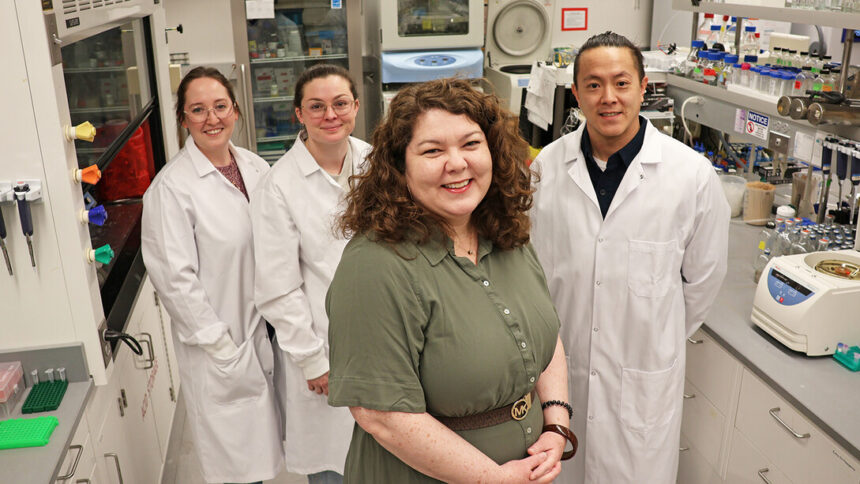
Buan’s team reflects Nebraska’s research hallmarks of teamwork, interdisciplinarity and commitment to training the next generation of scientists. Buan said their research benefits from numerous collaborators who share expertise in computational modeling, mathematics, chemistry, physics, computer science and more. And none of it would be possible without her laboratory’s team of students and postdocs, who do the day-to-day bench work that lays the foundation for tackling bigger-picture challenges.
“It’s truly a team effort,” Buan said. “It’s really the amazing care, effort and attention to detail that my trainees put into their work that makes it possible for our research to have real-world impact in the future.”
Original release: https://news.unl.edu/article/buan-aims-to-better-understand-biochemistry-of-methanogens
https%3A%2F%2Fwww.newswise.com%2Farticles%2Fbuan-aims-to-better-understand-biochemistry-of-methanogens%2F%3Fsc%3Drsla