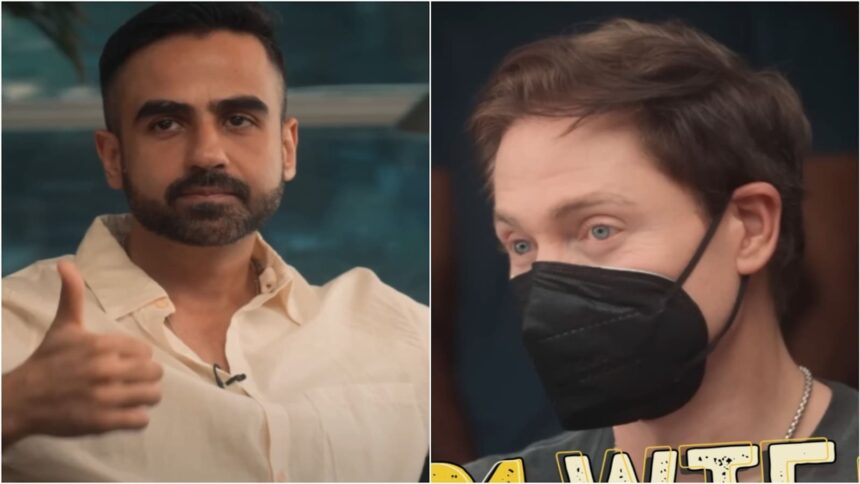
American tech millionaire and anti-ageing advocate Bryan Johnson has sparked a heated debate in India after revealing that he walked out of Nikhil Kamath’s podcast due to poor air quality. His decision has drawn significant attention on social media, with users debating the severity of pollution in India and the extent of Johnson’s reaction. In response to the backlash, he has taken to X to explain his stance and emphasize the detrimental impact of air pollution, urging Indians to “organise themselves” and take action.
Johnson, known for his strict anti-ageing regimen, claimed that addressing India’s poor air quality would have a greater impact on public health than curing cancer. “A firestorm of debate has ignited in India since I walked off a podcast due to the poor air quality. Indians, organize yourselves and take action. You will do more to improve India’s health by cleaning up the air than by curing cancer,” he wrote on X. Alongside his post, he shared a meme that has gone viral, which humorously contrasts his use of a face mask indoors with Indian children seemingly unaffected by poor air quality outdoors. The meme mocks his extreme sensitivity to pollution, highlighting the contrast between his reaction and the daily reality faced by millions of Indians.
Johnson had earlier revealed that he left Kamath’s podcast midway as he was unable to tolerate the air quality in the room, which had an air quality index of around 120. While praising Kamath as a “gracious host,” he explained that the room was circulating outside air, rendering his air purifier ineffective. By the time he exited, the indoor air quality index had climbed to 130, with PM2.5 levels at 75 micrograms per cubic metre—equivalent to smoking 3.4 cigarettes over a 24-hour period.
His brief stay in India reportedly led to noticeable health effects, including a rash, persistent eye and throat irritation, and overall discomfort. Johnson was particularly critical of how normalised air pollution has become in the country. “People would be outside running. Babies and small children exposed from birth. No one wore a mask, which can significantly decrease exposure. It was so confusing,” he wrote.
He further questioned why India’s leadership had not declared air pollution a “national emergency,” citing studies on its severe health effects. “The evidence shows that India would improve the health of its population more by cleaning up air quality than by curing all cancers,” he asserted. His comments have intensified discussions on India’s pollution crisis, drawing both criticism and support from the public.