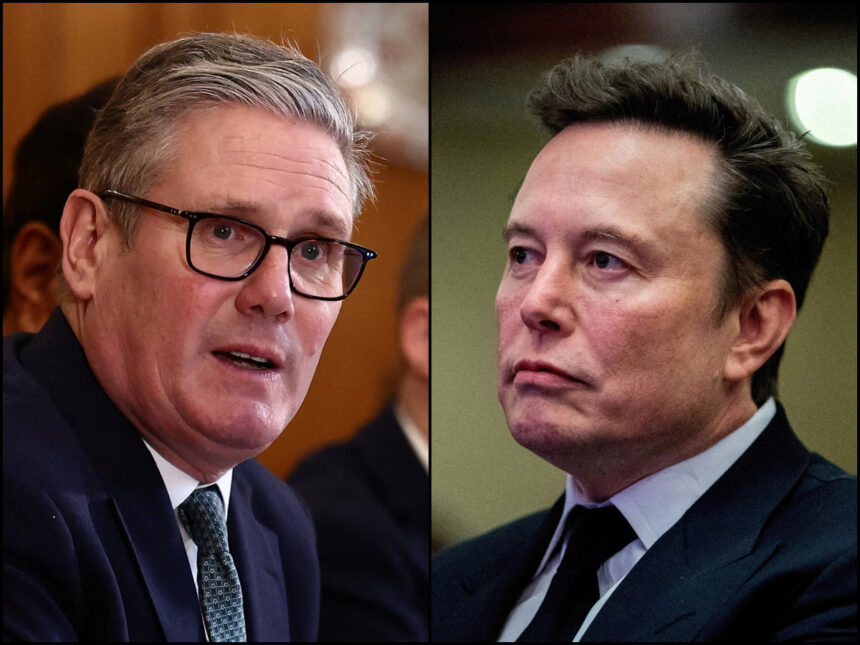
In a growing political dispute, a senior British government minister has strongly criticized Elon Musk’s recent intervention in UK politics, describing it as “misjudged and certainly misinformed.” The tech billionaire, known for his outspoken presence on social media, specifically targeted the UK’s Prime Minister Keir Starmer and other government figures over their handling of sensitive issues related to child sexual exploitation in northern England.
The controversy erupted after Musk, in a series of posts on his social media platform X, accused Keir Starmer, who was the director of public prosecutions from 2008 to 2013, of failing to bring justice to “rape gangs” operating in the UK. Musk also called for the imprisonment of Jess Phillips, the current Minister for the Prevention of Violence Against Women and Girls, accusing her of neglecting a request for a national inquiry into a child sexual exploitation scandal in Oldham, a town in northern England.
The remarks from Elon Musk have sparked outrage among several political figures, with Health Secretary Wes Streeting being among the most vocal in rebuking the billionaire’s comments. Speaking to ITV News, Streeting emphasized that Elon Musk’s criticisms were “wide of the mark” and based on misinformation. He stressed that the UK government takes the issue of child sexual exploitation “incredibly seriously,” noting that a strong commitment to addressing such serious matters was at the core of the government’s policy.
Streeting acknowledged that while Elon Musk had raised concerns that were worth addressing, his approach had been flawed. The minister stated that the government was open to collaboration with Elon Musk, who wields significant influence through his social media platform. “If he wants to work with us and roll his sleeves up, we’d welcome that,” Streeting said. He added that there was a role for Elon Musk to play in helping tackle the issue of child sexual exploitation, both in the UK and globally.
The issue Elon Musk raised revolves around the widespread abuse of young girls in a number of English towns and cities, including Rochdale, Rotherham, and Oldham, which came to light more than a decade ago. These incidents have sparked significant controversy, particularly after a series of court cases led to the conviction of dozens of men, mostly of South Asian Muslim descent. The victims were predominantly white girls, many of whom were vulnerable and in care.
Official inquiries into the incidents revealed that, in some cases, police and social workers had failed to intervene due to fears of being labeled as racist. The scandals have been seized upon by far-right figures, including Tommy Robinson, a notorious anti-immigration activist who has long highlighted these issues. Elon Musk, in his posts, expressed strong support for Robinson, claiming that he was “in prison for telling the truth” and should be freed.
Robinson has long promoted a narrative of exposing the so-called “grooming gangs” involved in the abuse, with Elon Musk echoing these claims on his platform. Elon Musk’s posts suggested that the Crown Prosecution Service (CPS) under Starmer’s leadership allowed the exploitation of young girls to continue without facing justice. However, official inquiries have not singled Starmer out for blame, and there is no evidence to suggest he attempted to block prosecutions due to concerns over Islamophobia.
Elon Musk’s remarks regarding Starmer and the CPS were met with criticism from various quarters. In one post, Elon Musk questioned the role of the CPS during Starmer’s tenure as its head, specifically pointing to the years between 2008 and 2013 when the exploitation was reportedly taking place. He also suggested that Starmer’s refusal to order a national inquiry into the sexual exploitation cases was an indication of “complicity.”
Later, Elon Musk posted a message in support of the idea of King Charles III dissolving the British Parliament, prompting another wave of reactions across political circles. Some saw this as an extension of Elon Musk’s involvement in UK political affairs, with others warning that his interventions were not as constructive as they could have been.
Nigel Farage, leader of the anti-immigration Reform UK party, weighed in on the issue, particularly regarding Elon Musk’s support for Robinson. Farage disagreed with Elon Musk’s view, explaining that Robinson was not imprisoned for his stance on grooming gangs but for contempt of court. Farage, who has had discussions with Elon Musk about financial support for his political party, defended Elon Musk, emphasizing that the billionaire had been “very supportive” of both him and the Reform UK party.
Elon Musk’s comments about the UK government and its handling of sensitive issues come at a time when political discourse in the UK is already highly charged. The issue of child sexual exploitation and the handling of grooming gang scandals have been at the forefront of public debate, especially as many see these incidents as emblematic of broader issues of immigration, race, and social integration. Elon Musk’s intervention, however, has added a new dimension to the debate, with some arguing that he should focus more on supporting the UK government’s efforts rather than casting doubt on their approach.
The dispute between Elon Musk and the UK government highlights the increasingly polarized nature of political discourse, not just in the UK but globally. While Elon Musk’s influence continues to grow, so does the scrutiny of his public statements. His remarks, particularly those targeting high-profile politicians like Keir Starmer and Jess Phillips, are unlikely to be the last in a series of contentious interventions in UK politics. As the issue of child sexual exploitation continues to be a flashpoint in the UK, the role of social media platforms and their owners in shaping public discourse will only become more significant in the years to come.