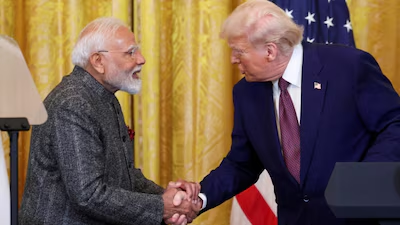
A bipartisan group of US lawmakers has introduced a significant resolution recognising the long-standing strategic value of the partnership between the United States and India, emphasising decades of deepening cooperation across defence, technology, trade, counterterrorism and education. The proposal underscores the belief that the relationship between the world’s two largest democracies is essential not only for mutual benefit but also for ensuring regional stability, economic resilience and a free and open Indo-Pacific in an increasingly complex global environment.
Growing Bipartisan Support for India, Historical Foundation of Cooperation and Rising Strategic Alignment
The resolution was introduced by Representatives Ami Bera, the longest-serving Indian American member of the US Congress, and Joe Wilson, a senior Republican leader from South Carolina. Their bipartisan initiative reflects the growing consensus within Washington that India is one of America’s most important strategic partners. This is not a recent shift but the result of a sustained policy direction maintained under several American presidents, regardless of their political affiliations.
The resolution notes that for more than three decades, successive administrations—from President Bill Clinton to Presidents George W Bush, Barack Obama, Donald Trump and Joe Biden—have actively strengthened ties with India. These governments collectively recognised India as a stabilising force in Asia, a partner in upholding democratic values, a key driver of economic growth and an indispensable contributor to shared regional priorities. The document highlights that this continuity of policy is rare in American foreign relations, underscoring the depth of bipartisan trust in the India–US partnership.
Defence cooperation forms a central pillar of this long-standing relationship. Over the years, India and the United States have conducted joint military exercises, enhanced maritime security cooperation, expanded intelligence sharing and developed frameworks for defence technology partnerships. The resolution acknowledges that these efforts have significantly strengthened the ability of both nations to safeguard international waters, maintain open sea lanes and respond to global security threats. The convergence of interests in the Indo-Pacific has further accelerated defence alignment, driven by concerns about maintaining freedom of navigation and resisting coercive actions that threaten regional balance.
In addition to defence, technological collaboration has emerged as a powerful force binding the two countries. The resolution points out that India and the US are working together in areas such as artificial intelligence, quantum computing, semiconductor development, cybersecurity, space research and emerging digital technologies. In a world where innovation determines strategic advantage, technology cooperation helps both countries modernise their capabilities while fostering interconnected research and development ecosystems.
Trade and economic ties are another cornerstone of the partnership. The United States is among India’s largest trading partners, and bilateral trade has grown significantly over the past two decades. The resolution stresses the need to continue strengthening investment opportunities, removing unnecessary obstacles and encouraging deeper commercial engagement. With global supply chains undergoing restructuring, both nations see value in closer economic coordination.
The resolution also highlights the importance of counterterrorism cooperation. India and the United States have worked closely to identify, monitor and disrupt terrorist networks, share intelligence and build operational capabilities to prevent attacks. Both countries recognise that terrorism remains a persistent global threat, requiring coordinated responses and long-term vigilance. In this context, the resolution acknowledges India’s experience in combating terrorism and the shared commitment of both countries to a safer international environment.
Education is another major area of cooperation emphasised in the resolution. The United States continues to host one of the largest populations of Indian students, contributing substantially to its academic institutions, research output and local economies. Indian scholars, engineers, medical professionals and entrepreneurs who have studied in the United States often go on to strengthen bilateral ties further. The resolution notes that educational exchanges support long-term understanding, mutual respect and collaboration between the two societies.
The resolution also recognises India’s growing global influence, its expanding economic power and its role as a critical partner in addressing global challenges. India’s leadership in climate action, health security, sustainable development and peacekeeping aligns with America’s broader foreign-policy goals. The resolution suggests that deeper collaboration in these areas will be essential as the world navigates climate emergencies, pandemics, geopolitical instability and technological disruption.
Importance of the Indo-Pacific Partnership, Shared Democratic Values and the Essential Role of the Indian American Community
One of the central themes of the bipartisan resolution is the increasing strategic importance of the Indo-Pacific region. This vast geographic area has become the centre of global economic activity and geopolitical competition. With shifting power dynamics, the region faces challenges related to territorial disputes, maritime security, supply-chain vulnerabilities, cyber threats and the need to preserve a rules-based international order. The resolution makes it clear that India’s partnership is indispensable in shaping a stable and peaceful Indo-Pacific.
The document highlights India’s leadership in promoting freedom of navigation, transparency, open trade routes and respect for sovereignty—principles that also form the foundation of America’s Indo-Pacific strategy. Joint naval exercises, maritime domain awareness cooperation and coordination with other regional democracies underscore the shared goal of maintaining stability and security in the region.
Another significant component of the resolution is its focus on addressing 21st-century challenges. These include cyberattacks, disinformation campaigns, emerging technologies such as artificial intelligence, climate-related disruptions, global pandemics and the evolution of transnational terrorist networks. The resolution asserts that no single country, regardless of size, can tackle these complex issues alone. Instead, deeper bilateral cooperation between India and the United States is necessary to build resilient systems and pursue shared solutions.
The resolution also brings attention to the enduring people-to-people ties between the two nations. The Indian American community, numbering in the millions, plays a significant role in strengthening bilateral ties. They contribute across sectors such as medicine, science, education, technology, business and public service. The resolution acknowledges their contributions and highlights how Indian Americans serve as a cultural bridge connecting the two democracies.
This community’s achievements in the United States have helped reshape perceptions, build trust and foster deeper engagement between New Delhi and Washington. Their influence is visible not only in economic and technological sectors but also in political representation, with Indian Americans serving at various levels of government and public leadership. The resolution acknowledges that these social and cultural links enrich the partnership and make it more resilient.
The resolution expresses a forward-looking vision for India–US relations. Instead of focusing only on past achievements, it calls for continued cooperation to address emerging challenges. It outlines the need to maintain high-level diplomatic engagement, expand defence partnerships, encourage research collaborations, strengthen economic ties and advance democratic values globally.
The two countries, according to the resolution, share a responsibility to promote freedom, stability and prosperity in an increasingly uncertain world. The partnership between India and the United States is framed not merely as a bilateral relationship but as a defining global alliance that can shape the future of the international order.
The bipartisan nature of the resolution demonstrates that support for India transcends political divisions in the United States. In an era of intense domestic polarisation, India remains one of the few foreign-policy issues that receives consistent backing from both major parties. This consensus strengthens the credibility of the resolution and emphasises the long-term nature of the partnership.
The resolution ultimately serves as a reaffirmation of trust, mutual respect and shared strategic purpose, highlighting the belief that India and the United States will remain essential partners in ensuring global security and democratic resilience for decades to come.