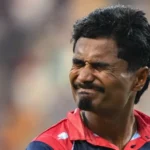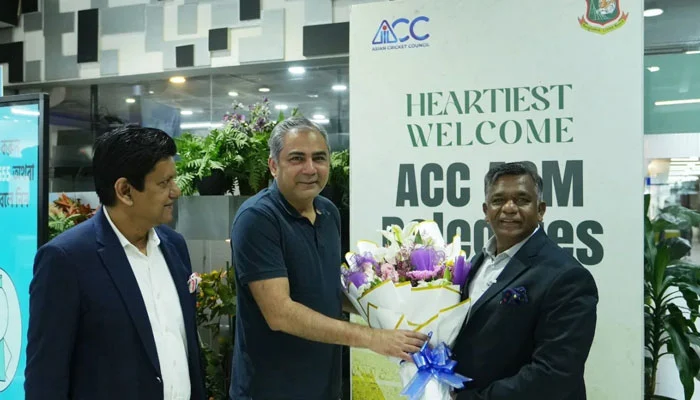
The intensifying uncertainty surrounding the India–Pakistan clash at the ICC Men’s T20 World Cup 2026 has triggered urgent diplomatic and administrative activity within global cricket governance, as Bangladesh Cricket Board chairman Aminul Islam arrived in Pakistan ahead of an emergency International Cricket Council meeting. The visit underscores the seriousness of the crisis confronting the tournament, as the ICC grapples with the implications of Pakistan’s government-backed refusal to play against India, a decision that threatens the competitive, commercial, and regulatory framework of the global event scheduled from February 7 to March 8.
Emergency ICC Consultations and Regional Stakeholder Engagement
The emergency ICC meeting, expected to be convened virtually, has been called to address the growing uncertainty around one of the tournament’s most anticipated fixtures. The India–Pakistan match is not merely a sporting contest but a central pillar of the ICC’s event planning, broadcast commitments, and competitive balance. Pakistan’s decision to bar its national team from taking the field against India has placed the ICC in a complex position, requiring immediate consultation with member boards to assess possible outcomes and contingency measures.
Aminul Islam’s arrival in Pakistan signals Bangladesh’s active involvement in the discussions as a key ICC member. His presence reflects the broader concern among full and associate members about the precedent such a standoff could set for international tournaments. Beyond participating in the ICC meeting, Islam is also expected to hold bilateral discussions with Pakistan Cricket Board chairman Mohsin Naqvi, indicating parallel diplomatic engagement outside the formal ICC process. These interactions are understood to be focused on understanding Pakistan’s position, assessing possible compromises, and gauging the likelihood of a resolution before the tournament schedule is irreversibly disrupted.
The emergency nature of the meeting follows reports that the ICC has begun exploring informal channels to reopen dialogue with Pakistan. The objective of these back-channel efforts is to determine whether Pakistan’s stance is negotiable or whether the governing body must prepare for structural changes to the tournament format. With multiple member boards expected to participate in the meeting, the ICC faces mounting pressure to demonstrate institutional authority while balancing the sovereign decisions of national governments that increasingly intersect with sport.
Government Intervention, Mediation Efforts, and the Limits of Sporting Autonomy
At the heart of the crisis lies Pakistan’s assertion that political considerations cannot be separated from sporting engagement with India. The federal government’s decision to bar the national team from the India fixture has been explicitly endorsed at the highest political level, reinforcing the perception that the matter extends beyond the control of the Pakistan Cricket Board. Prime Minister Shehbaz Sharif has publicly defended the decision, framing it as a necessary response to what he described as the politicisation of sport and asserting that the government’s stance was reached after careful and collective deliberation.
This firm political backing has narrowed the ICC’s room for manoeuvre. While the council traditionally operates on the principle of keeping politics separate from sport, the reality of international cricket has increasingly challenged that ideal. In response, the ICC has reportedly assigned Deputy Chairman Imran Khawaja the task of initiating informal talks with the PCB. Acting in a mediatory capacity, Khawaja’s role is understood to involve easing tensions and exploring whether assurances, scheduling adjustments, or neutral frameworks could persuade Pakistan to reconsider its refusal.
However, the mediation effort faces significant structural limitations. Pakistan’s position is not framed as a sporting disagreement but as a matter of national policy, making compromise inherently complex. Indian authorities, meanwhile, have not publicly indicated any change in stance, leaving the ICC caught between two sovereign positions with limited leverage over either. The involvement of multiple ICC members in the emergency meeting reflects growing concern that failure to resolve the issue could undermine the council’s credibility and disrupt the competitive integrity of the World Cup.
Beyond the immediate fixture, the standoff raises broader questions about governance, precedent, and the enforceability of ICC regulations. If a member nation is permitted to withdraw from marquee matches on political grounds without consequence, other boards may feel emboldened to follow suit in future tournaments. This prospect has heightened anxiety within the ICC, particularly among boards that rely heavily on predictable scheduling and commercial stability.
As the World Cup progresses toward its opening phase, the absence of clarity continues to cast a shadow over the tournament. The emergency meeting, bilateral engagements, and mediation efforts now represent the final institutional mechanisms available to prevent a rupture that could redefine the relationship between politics and international cricket governance.