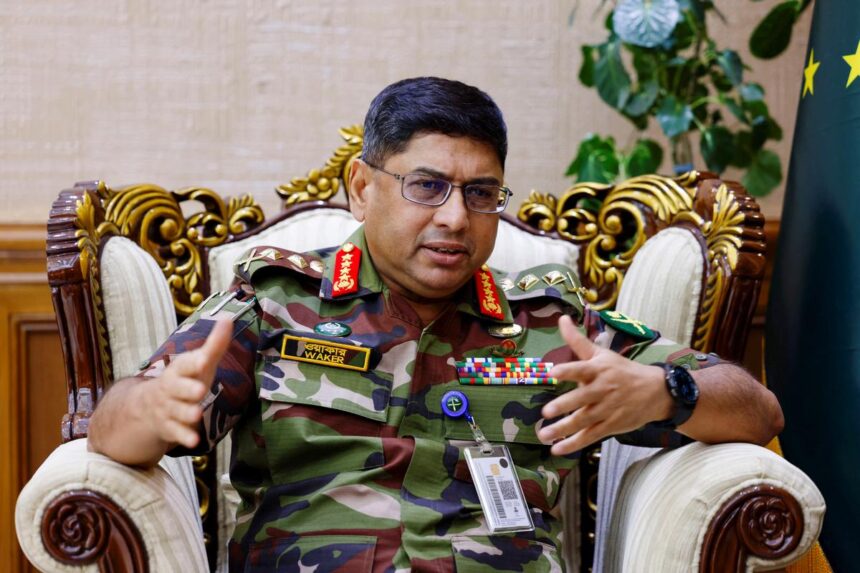
Bangladesh is once again facing political turbulence. A rift has emerged between the country’s Army Chief General Waker-uz-Zaman and interim government head Professor Muhammad Yunus over the timeline for holding general elections.
Yunus May Step Down Amid Rising Tensions
Speculations are growing that Nobel laureate Muhammad Yunus may resign from his role as interim leader. Yunus had stepped in after former Prime Minister Sheikh Hasina resigned and fled to India amid mass anti-government protests in August 2024.
This has brought Army Chief Waker-uz-Zaman into sharp focus. But who is he?
Who is General Waker-uz-Zaman?
Born in Dhaka in 1966, General Waker-uz-Zaman has nearly four decades of military experience. A graduate of the Bangladesh Military Academy, he holds two Master’s degrees in Defence Studies—one from the National University of Bangladesh and another from King’s College, London.
He joined the infantry in 1985 and commanded a Bangladesh Infantry Battalion. He has also served as an instructor and was actively involved in UN peacekeeping operations.
Zaman held key positions in the Army Headquarters and served as Principal Staff Officer under Prime Minister Hasina. His contributions to military modernization earned him prestigious honours like the Army Medal of Glory (SGP) and Extraordinary Service Medal (OSP).
India’s Concerns Over Zaman’s Appointment
Before becoming Army Chief in June 2024, Indian intelligence had reportedly raised concerns about Zaman’s appointment. Indian officials warned that he may be “pro-Pakistan” and pointed to health issues and better-qualified candidates.
However, Hasina did not act on those warnings. Zaman’s family ties to Hasina—through his wife, who is the daughter of former Army Chief General Mustafizur Rahman—may have influenced his elevation.
Army Steps In After Hasina’s Exit
After the collapse of Hasina’s government in August 2024, General Zaman announced an interim setup. In a televised address, he urged citizens to support the army-led efforts to restore stability amid economic collapse and violence.
Rift Between Zaman and Yunus Widens
Muhammad Yunus was appointed interim chief adviser on August 6, 2024. While Zaman initially backed the interim administration, he later criticized its inefficiency, especially in restoring police order.
His private meeting with former PM Khaleda Zia in January 2025 raised eyebrows and triggered speculation about his next steps.
The rift became public when Yunus announced that elections could not be held by December. A day earlier, Zaman had warned military commanders that elections must be held by then, asserting that only an elected government should chart the nation’s future.
With Yunus reportedly considering resignation, the question remains: will Zaman take full control of the country?