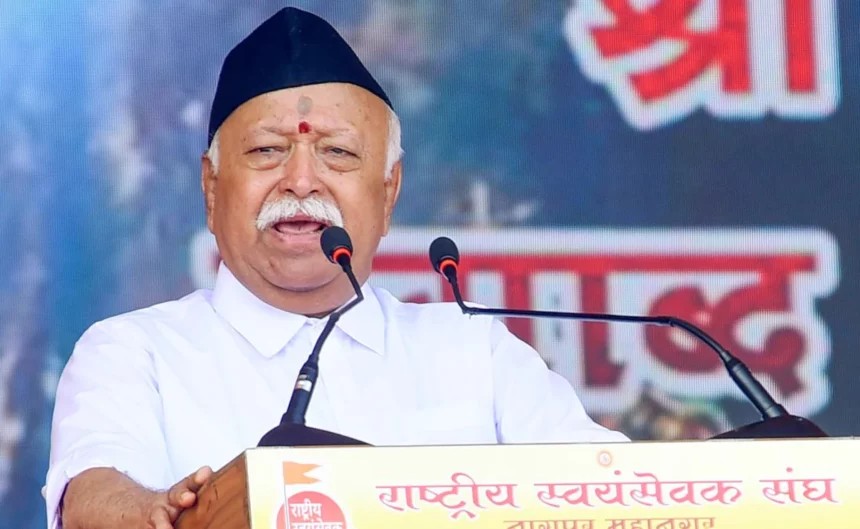
Rashtriya Swayamsevak Sangh chief Mohan Bhagwat on Sunday spoke at length about the challenges faced by Hindu minorities in Bangladesh, urging unity among Hindus worldwide, while addressing a public dialogue in Kolkata to mark 100 years of the Rashtriya Swayamsevak Sangh.
Speaking at the centenary event in Kolkata, Bhagwat described the situation of Hindus in Bangladesh as difficult because they are a minority, stressing that unity among Hindus, both within Bangladesh and globally, was essential for their safety and dignity. His remarks came amid heightened concern over recent incidents of violence against members of the Hindu community in Bangladesh, which he referred to as a matter of serious humanitarian and cultural concern.
Bhagwat’s address combined reflections on the Sangh’s ideological foundations, India’s civilisational identity, and the responsibilities he believes India and Hindus worldwide bear toward communities facing persecution. His comments drew significant attention because they linked regional developments in Bangladesh with broader questions about identity, nationhood, and global Hindu solidarity.
Bhagwat’s remarks on Bangladesh and the call for Hindu unity
During his speech, Mohan Bhagwat said the condition of Hindus in Bangladesh remained fragile primarily because of their minority status. He argued that history shows minority communities often face insecurity when social cohesion breaks down, and in such circumstances, unity becomes a critical source of strength. According to Bhagwat, if Hindus in Bangladesh wish to remain safe, they must remain united, while Hindus across the world should extend moral and practical support to them.
He further stated that India, in his view, holds a unique responsibility in this context. Bhagwat said India should help as much as possible within its own borders, describing the country as the only homeland for Hindus. He added that while India must act within constitutional and diplomatic limits, it could not remain indifferent to the plight of Hindu communities in neighbouring countries.
The RSS chief also referred to the role of the Indian government, suggesting that authorities in New Delhi would have to pay attention to developments in Bangladesh. He remarked that governments often work in ways that are not fully visible to the public, noting that some actions are disclosed while others remain confidential. Bhagwat implied that efforts may already be underway, though their outcomes are not always immediate or guaranteed.
His remarks were delivered against the backdrop of growing reports of violence against minorities in Bangladesh, which have circulated widely on social media and in regional discussions. Bhagwat framed these incidents not merely as isolated crimes but as warning signs of deeper societal tensions that require sustained attention and collective response.
At the same event, Bhagwat reiterated the Sangh’s long-held ideological position regarding India’s identity. He stated that India is a Hindu nation by virtue of its civilisational roots, arguing that this reality does not require constitutional validation. Drawing an analogy, he said that just as the sun rises in the east without legal endorsement, India’s cultural character exists independent of formal declarations. According to him, anyone who considers India their motherland and respects Indian culture is part of this civilisational framework.
He also addressed debates around constitutional amendments, saying that even if Parliament were to add or not add the term “Hindu nation” to the Constitution, it would make little difference to the Sangh’s worldview. Bhagwat maintained that cultural identity, in his view, is deeper than legal terminology and cannot be altered by the inclusion or exclusion of specific words.
Violence in Bangladesh and the broader political context
Bhagwat’s reference to Bangladesh was closely tied to a recent incident that has drawn international attention. A Hindu youth was reportedly beaten to death in Bhaluka, near Dhaka, after allegations of insulting religion. The victim, identified as Dipu Chandra Das, was accused of blasphemy, an allegation that later investigations suggested was unfounded.
According to accounts that emerged after the incident, the youth was stripped, assaulted, and subjected to extreme violence before his death. Videos of the incident circulated widely online, intensifying outrage and concern among human rights groups and minority organisations. The incident became a focal point in discussions about minority safety in Bangladesh, particularly within Hindu communities in India and abroad.
Subsequent statements by Bangladeshi security officials indicated that no evidence was found to support claims that the victim had made offensive remarks or posts on social media. This revelation further deepened concerns, as it suggested that the violence was driven by misinformation and mob action rather than any verified provocation.
Bhagwat referred to such incidents as examples of why minority communities face heightened vulnerability in certain environments. Without naming specific institutions or individuals, he emphasised the need for social vigilance and solidarity, arguing that disunity often emboldens forces that exploit fear and prejudice.
The RSS chief’s comments have also been interpreted within the larger political discourse in India, especially at a time when regional instability, minority rights, and cross-border relations remain sensitive subjects. His remarks on India’s role and the government’s responsibility were seen as a call for a balance between diplomatic engagement and moral responsibility.
The centenary programme itself was designed as a reflective dialogue on the Sangh’s journey over a hundred years, its ideological evolution, and its vision for the future. Bhagwat used the platform not only to commemorate the organisation’s history but also to connect its philosophy with contemporary challenges faced by Hindu communities globally.
Observers note that the speech underscored the RSS’s emphasis on cultural unity rather than territorial expansion or political domination. Bhagwat repeatedly framed unity as a defensive and moral necessity rather than an aggressive posture, particularly in the context of minority safety.
The remarks have generated debate across political and civil society circles, with supporters viewing them as a call for humanitarian solidarity, while critics question the broader implications for regional diplomacy and internal pluralism. Nonetheless, the speech has clearly positioned the issue of minority safety in Bangladesh within the wider narrative of Hindu identity and responsibility, a theme likely to continue shaping discourse in the coming months.
As discussions continue around the incident in Bangladesh and Bhagwat’s statements in Kolkata, attention remains focused on how governments, civil society, and international actors respond to concerns about minority protection, communal harmony, and accountability in the region.