

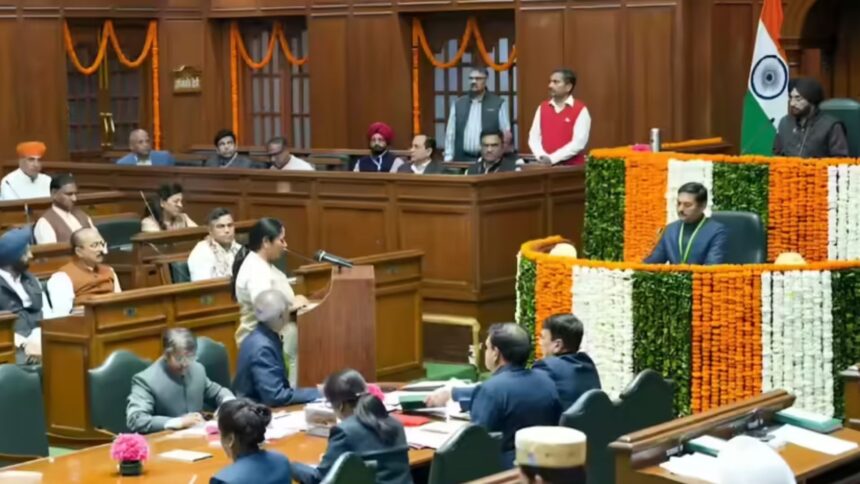
The CAG audit report on Delhi’s finances for 2020–21 highlights increasing fiscal deficit, weak budget utilization, and inefficiencies in expenditure and financial management.
New Delhi, 31 March 2021
The Comptroller and Auditor General of India presented Report No. 1 of 2022 on the State Finances of the Government of the National Capital Territory of Delhi for the financial year ending 31 March 2021. The report, prepared under Section 48 of the GNCTD Act, 1991, provides a comprehensive analysis of the government’s fiscal position, budgetary processes, accounting systems, and performance of public sector undertakings. It is based on audited accounts, budget documents, and other financial data.
Scope and Structure of the Report
The report is divided into five chapters. Chapter I provides an overview of Delhi’s fiscal profile, including Gross State Domestic Product (GSDP), budgetary processes, and overall financial position. Chapter II analyzes the finances of the government, including revenue receipts, expenditure patterns, subsidies, and debt. Chapter III examines budgetary management and deviations from financial norms. Chapter IV focuses on the quality of accounts and compliance issues, while Chapter V reviews the performance of public sector undertakings (PSUs).
Fiscal Position and Revenue Trends
The report indicates that Delhi maintained a revenue surplus of ₹1,450 crore during 2020–21, equivalent to 0.18 percent of GSDP. This suggests that revenue receipts were sufficient to meet revenue expenditure.
However, the fiscal deficit increased significantly, rising from ₹1,051 crore in 2016–17 to ₹6,708 crore in 2020–21. This increase reflects growing financial pressures and higher expenditure levels.
Revenue receipts declined by ₹5,272 crore (11.18 percent) during the year. Of the total revenue, 72.63 percent was generated from the government’s own resources, while 27.37 percent came from central grants.
Expenditure Patterns and Subsidies
The report highlights that revenue expenditure accounted for 82.14 percent of total expenditure, indicating a high share of recurring expenses such as salaries, pensions, and subsidies.
Capital expenditure declined during the year, suggesting reduced investment in infrastructure and long-term assets.
Subsidy expenditure increased sharply from ₹2,160 crore to ₹4,177 crore, reflecting a significant rise in government support programs.
Investment and Debt Profile
The audit reveals low returns on government investments, ranging between 0.05 percent and 0.08 percent, compared to an average interest rate of around 7 percent on borrowings. This indicates inefficient utilization of public funds.
The total outstanding debt of the government stood at ₹41,002 crore, showing a steady increase over time. The report emphasizes the need for prudent debt management to ensure long-term fiscal sustainability.
Budgetary Management Issues
The report identifies major gaps in budget planning and execution. Savings amounting to ₹12,996 crore remained unutilized, indicating poor estimation and implementation of budget provisions.
A significant portion of expenditure, about 17.93 percent, was incurred in the last month of the financial year, reflecting a “rush of expenditure” that may compromise efficiency and transparency.
Several schemes failed to utilize allocated funds fully, pointing to weaknesses in planning, monitoring, and execution.
Accounting and Financial Reporting Issues
The report highlights deficiencies in accounting practices and financial reporting. Thousands of utilization certificates remained pending, raising concerns about accountability in fund usage.
Bills amounting to ₹735 crore were pending settlement, indicating delays in financial processing.
Instances of incorrect classification of expenditure were also noted, which can distort financial reporting and decision-making.
Public Sector Undertakings (PSUs)
The performance of PSUs in Delhi showed mixed results. Out of 18 public sector undertakings, 10 were operating in profit while 7 were incurring losses.
The total accumulated losses of PSUs stood at ₹6,162 crore, with the majority attributed to the Delhi Transport Corporation.
The report also points to low returns on investment in PSUs and emphasizes the need for improved financial and operational efficiency.
Key Observations
The audit underscores several structural issues affecting Delhi’s financial management. These include rising fiscal deficit despite revenue surplus, declining capital expenditure, increasing subsidies, and weak budget utilization.
The combination of low investment returns and high borrowing costs further stresses the financial position of the government.
Recommendations
The report recommends strengthening budget planning and ensuring realistic estimates to avoid large savings. It also emphasizes improving fund utilization and monitoring mechanisms to ensure timely implementation of schemes.
Enhancing transparency and accuracy in accounting practices is identified as a key priority. The report also calls for better debt management strategies and improved performance of public sector undertakings.
Conclusion
The CAG report presents a comprehensive assessment of Delhi’s financial position for 2020–21, highlighting both strengths and challenges. While the presence of a revenue surplus indicates some fiscal stability, the rising fiscal deficit, inefficiencies in expenditure, and weaknesses in financial management require immediate attention.
Addressing these issues through improved planning, monitoring, and governance will be essential for ensuring sustainable and efficient public financial management in Delhi.