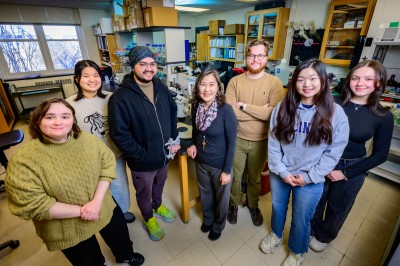
Newswise — CHAMPAIGN, Ill. — The gene most strongly correlated with Alzheimer’s disease also boosts seizure activity by decreasing levels of ion pumps and energy-producing enzymes in neurons, a new study by researchers at the University of Illinois Urbana-Champaign found. Furthermore, the energy-making pathway was stimulated and seizures reduced in mouse models of Alzheimer’s disease by administration of a blood pressure medication, pointing to a potential treatment to reduce seizure activity in those with the gene, APOE4.
“Seizures are very prevalent symptoms of Alzheimer’s disease patients. 10-22% experience unprovoked seizures, while up to 50% show subclinical epileptic activity, or hyperactivity in the brain,” said study leader Hee Jung Chung, a professor of molecular and integrative physiology at the University of Illinois. “The APOE4 gene increases the risk of developing Alzheimer’s disease twelvefold compared to the normal APOE3 gene — and, interestingly, it also has been linked with seizures. We already know that seizures increase dementia risk and accelerate its progression. What we wanted to know in this study was when and why hyperactivity of the brain occurs in Alzheimer’s disease patients. Can we stop it? And if so, does that mitigate dementia risk and disease progression?”
Chung’s group first set out to determine when the brain becomes hyperactive in mice with the human APOE4 gene. This was an important question, since most studies only look at one age group, said Illinois postdoctoral researcher Tanveer Singh, the co-first author of the paper along with Emma Bridgeman, an undergraduate student at the time of the research. They found the mice began to have more seizures and seizure-induced deaths between 5.5 and 7 months of age, roughly equivalent to a human in their 30s. Younger mice at 2-3 months of age appeared unaffected.
The researchers then studied seizure activity in mice with APOE4 and tangles of tau protein in the brain, a hallmark of Alzheimer’s disease. They found that female mice with both APOE4 and tau tangles had more severe seizures, though the presence of tau tangles did not make a difference for male mice.
“There’s a sex difference in Alzheimer’s disease-related dementia and seizure prevalence in humans too, with females more likely to develop Alzheimer’s disease,” Chung said. “We don’t know why; however, our data suggests that the difference in seizure susceptibility may play a role.”
Next, the researchers turned to the question of how APOE4 increases brain hyperactivity and seizures. They looked closely at the genes and proteins in the hippocampus, the main brain region affected by Alzheimer’s disease. They found reduced levels of the sodium and potassium ion pump that regulates neuron activity.
“If we decrease this pump activity, it leads to increased firing of action potentials of neurons, indicative of neuronal network hyperactivity that underlies seizures,” Chung said.
The pump itself is not a good treatment target due to its ubiquitous presence in all brain cell types, so instead the researchers investigated ways to increase ATP, the cellular energy that drives the pump. They found that both ATP and the enzymes that produce it during metabolism were in low supply in the hippocampi of APOE4 mice compared to those with the APOE3 gene.
“Our study revealed a clear link between reduced ATP levels, ion pump dysfunction and seizure susceptibility,” Singh said.
To increase ATP levels, they treated the mice with the drug terazosin, a clinically available blood pressure drug that has been recently found to increase the ATP-making enzymes. Terasozin treatment increased ATP levels in the hippocampus and decreased seizure activity in the APOE4 mice, as well as the female mice with both APOE4 and tau tangles.
The researchers published their results in the journal Neurobiology of Disease (DOI:10.1016/j.nbd.2025.107246).
“Based on these results, we think that terazosin could be repurposed to reduce seizures or brain hyperactivity in Alzheimer’s disease patients. The next phase of this research is to see whether reducing the seizures this way can reduce memory deficits or slow dementia progression,” Chung said.
Additionally, the researchers then combined terazosin with an inhibitor that makes sure glucose in neurons is converted to the next step of the ATP-making metabolic pathway rather than converted to lactose, as can happen during brain hyperactivity or seizures. This combination further enhanced ATP levels and suppressed seizure activity, indicating that methods to increase ATP in the hippocampus are worth exploring for controlling seizure activity in those with the APOE4 gene.
“We know that exercise improves cognition and increases ATP production. However, most aged populations, and especially Alzheimer’s disease patients, do not get enough exercise. We are now investigating if terazosin treatment alone or in combination with voluntary exercise mitigate memory loss and brain pathology in APOE4 mice by blocking ATP reduction and seizures,” Chung said.
This research was supported by the U.S. National Institutes of Health through grants R01NS126584, R01 NS10019 and RF1 AG083625 and the Alzheimer’s Association. Chemical and biomolecular engineering professor Hyunjoon Kong and physics professor Paul Selvin were co-authors of the work.
https%3A%2F%2Fwww.newswise.com%2Farticles%2Falzheimer-s-gene-boosts-seizures-but-pathway-can-be-targeted-study-finds%2F%3Fsc%3Drsla