
• English
  • Hindi
  • Punjabi
  • Marathi
  • German
  • Gujarati
  • Urdu
  • Telugu
  • Bengali
  • Kannada
  • Odia
  • Assamese
  • Nepali
  • Spanish
  • French
  • Japanese
  • Arabic
  • Home
  • Noida
  • National
    • BulletsIn
    • cliQ Explainer
    • Government Policy
    • New India
  • International
    • Middle East
    • Foreign
  • Entertainment
  • Business
    • Tender News
  • Sports
    • IPL2025
  • Services
    • Lifestyle
    • How To
    • Spiritual
      • Festival and Culture
    • Tech
Notification
  • Home
  • Noida
  • National
    • BulletsIn
    • cliQ Explainer
    • Government Policy
    • New India
  • International
    • Middle East
    • Foreign
  • Entertainment
  • Business
    • Tender News
  • Sports
    • IPL2025
  • Services
    • Lifestyle
    • How To
    • Spiritual
      • Festival and Culture
    • Tech
  • Home
  • Noida
  • National
    • BulletsIn
    • cliQ Explainer
    • Government Policy
    • New India
  • International
    • Middle East
    • Foreign
  • Entertainment
  • Business
    • Tender News
  • Sports
    • IPL2025
  • Services
    • Lifestyle
    • How To
    • Spiritual
      • Festival and Culture
    • Tech
  • Noida
  • National
  • International
  • Entertainment
  • Business
  • Sports
CliQ INDIA > International > Foreign > Allowing Atoms to Come and Go Opens the Door to Better Materials Modeling
ForeignInternational

Allowing Atoms to Come and Go Opens the Door to Better Materials Modeling

cliQ India
cliQ India
Share
5 Min Read
SHARE

Newswise — Most materials, especially metals and ceramics, are crystals. Their atoms are arranged in three-dimensional lattices that repeat the same exact pattern, over and over again. But there’s a well-known saying in materials science: “Crystals are like people. It is the defects that tend to make them interesting.”

In a new study, published in Physical Review Letters, researchers from Lawrence Livermore National Laboratory (LLNL) created a new model for crystal defects at realistic temperatures. The simulation technique overcomes long-standing challenges in the field to calculate material structure and properties that were previously impossible to obtain. The result points the way toward improved production and performance of materials.

The work focused on two types of defects: point defects and grain boundaries. Point defects arise when atoms are missing in the lattice or when extra atoms are wedged in between the regular structure. Grain boundaries occur where two crystals with different orientations meet. Imagine the latter defect like a patchwork quilt where multiple pieces of fabric are stitched together at the seams.

“Cracks often find it easier to grow along grain boundaries, which can cause materials to fracture,” said author and LLNL postdoctoral researcher Flynn Walsh. “This is just one example of how defects affect the properties of materials ranging from protective walls in fusion energy plants to the magnets that power most electric motors.”

To improve technology based on these materials, researchers need to understand what’s happening to the crystal structure in complex defects like grain boundaries. While it is technically possible to image these defects, the associated experiments are very difficult. Modeling, therefore, is critical.

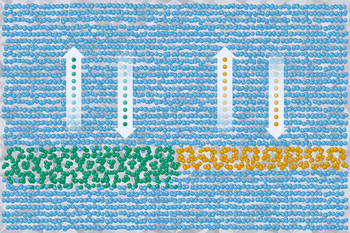
The new simulation technique advances the field with a simple but powerful idea: It allows atoms to come and go from the simulation. In a real-world defect, nature adjusts by moving atoms around until it finds a stable state. The team wanted to replicate that phenomenon.

“The conventional way to perform these simulations is to directly add and remove atoms, but this doesn’t work in solid crystals because the energy barriers are too high,” said Walsh. “Our approach is instead based on gradually adding and removing atoms. The basic idea is simple but doing it efficiently and correctly was surprisingly difficult.”

Instead of abruptly shoving an atom through a packed crowd of its fellows, the model softly pushes or pulls it into place.

“For the first time, this new technique opens the door to predicting grain boundary structures and phase transitions at finite temperatures,” said Timofey Frolov, LLNL scientist and principal investigator on the project. “This enables more accurate modeling of materials used in extreme environments such as fusion reactors.”

The method is more computationally demanding than traditional approaches and greatly benefited from LLNL’s supercomputing resources. But Walsh emphasized that the most important factor in its success was the research environment at the Laboratory. Much like defects make crystals interesting, the people involved (and their unique quirks and expertise) made this project possible.

“I was able to think deeply about this problem for a year and half with the guidance of experts in different areas of physics and materials science,” Walsh said.

Other LLNL authors included Babak Sadigh and Joseph McKeown. The work was funded by Frolov’s Department of Energy early career project and McKeown’s Laboratory Directed Research and Development Strategic Initiative. The LLNL Institutional Computing Grand Challenge provided computational resources.


https%3A%2F%2Fwww.newswise.com%2Farticles%2Fallowing-atoms-to-come-and-go-opens-the-door-to-better-materials-modeling%2F%3Fsc%3Drsla


You Might Also Like

Meghan Markle faces CEO search challenges for brand launch amid staff departures | CliqExplainer
Maria De Jesus, The Role of Mobility in HIV Intervention Engagement and Community Mobilization among Female Sex Workers Living with HIV in the Dominican Republic
Amid warnings by US, Pak Defence Minister hopeful of Iran-Pakistan gas pipeline completion
Canada releases list of products covered in retaliatory tariffs on US goods
Taiwan increased defence spending by 24.2 pc in 2023 amid growing Chinese threat

Sign Up For Daily Newsletter

Be keep up! Get the latest breaking news delivered straight to your inbox.
By signing up, you agree to our Terms of Use and acknowledge the data practices in our Privacy Policy. You may unsubscribe at any time.
Share This Article
Facebook Whatsapp Whatsapp Telegram Copy Link Print
Share
What do you think?
Love0
Sad0
Happy0
Angry0
Wink0
Previous Article Lisa Ray reflects on "difficult events" in her second home Dubai
Next Article India beat Italy 1-0 in semi-final of FIH Hockey World Cup Qualifiers 2026

Stay Connected

FacebookLike
XFollow
InstagramFollow
YoutubeSubscribe
TelegramFollow
- Advertisement -
Ad imageAd image

Latest News

Bengal Falta Repoll 2026: Massive Security Deployment After Election Controversy | Cliq Latest
National
May 21, 2026
Peddi Promotion Event In Bhopal: Ram Charan And AR Rahman Ready For Mega Show | Cliq Latest
Entertainment
May 21, 2026
Junior NTR Dragon Teaser Out: NTR Stuns Fans With Intense Assassin Avatar | Cliq Latest
Entertainment
May 21, 2026
KKR Vs MI IPL 2026: Manish Pandey And Bowlers Revive Kolkata Playoff Dream | Cliq Latest
Sports
May 21, 2026

//

We are rapidly growing digital news startup that is dedicated to providing reliable, unbiased, and real-time news to our audience.

We are rapidly growing digital news startup that is dedicated to providing reliable, unbiased, and real-time news to our audience.

Sign Up for Our Newsletter

Sign Up for Our Newsletter

Subscribe to our newsletter to get our newest articles instantly!

Follow US

Follow US

© 2026 cliQ India. All Rights Reserved.

CliQ INDIA
  • English – अंग्रेज़ी
  • Hindi – हिंदी
  • Punjabi – ਪੰਜਾਬੀ
  • Marathi – मराठी
  • German – Deutsch
  • Gujarati – ગુજરાતી
  • Urdu – اردو
  • Telugu – తెలుగు
  • Bengali – বাংলা
  • Kannada – ಕನ್ನಡ
  • Odia – ଓଡିଆ
  • Assamese – অসমীয়া
  • Nepali – नेपाली
  • Spanish – Española
  • French – Français
  • Japanese – フランス語
  • Arabic – فرنسي
Welcome Back!

Sign in to your account

Username or Email Address
Password

Lost your password?



