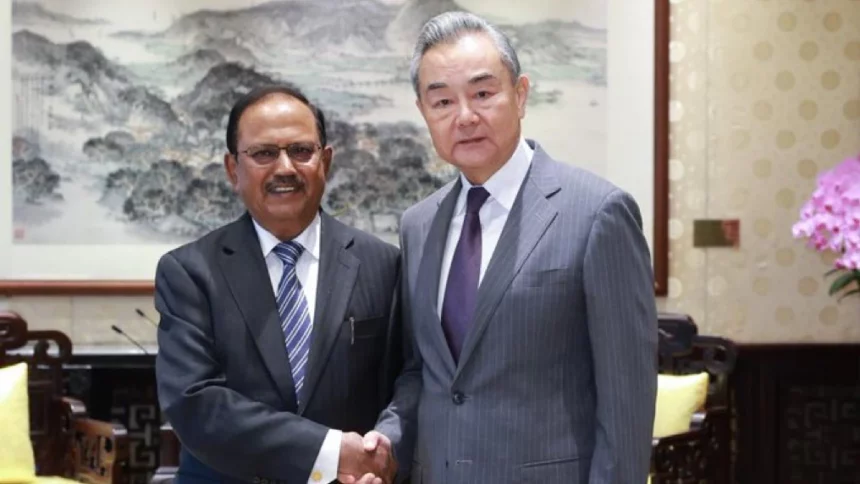
India’s National Security Advisor Ajit Doval met Chinese Foreign Minister Wang Yi in Beijing on Monday, pushing for stronger counter-terrorism cooperation and a more stable regional environment. In a conversation widely interpreted as a subtle message to China to influence Pakistan on terrorism issues, Ajit Doval emphasized the importance of eliminating terror networks to secure lasting peace in South Asia.
Counterterrorism and regional security take center stage
During the meeting, Ajit Doval highlighted terrorism as a critical challenge threatening regional stability. His remarks, though diplomatically framed, hinted at India’s growing frustration with Pakistan-based terror outfits and its expectation that China, as a regional heavyweight and close ally of Pakistan, should play a more responsible role. This comes just weeks after India launched Operation Sindoor in response to the Pahalgam massacre, which saw 26 civilians killed in an attack orchestrated by Pakistan-backed militants.
Ajit Doval’s emphasis on terrorism coincides with a broader Indian diplomatic strategy to internationalize its security concerns and seek multilateral cooperation in forums like the Shanghai Cooperation Organization (SCO), which is currently chaired by China. The meeting in Beijing also sets the stage for deeper conversations during the upcoming SCO summit, where Defence Minister Rajnath Singh is expected to represent India.
India-China dialogue signals thaw in bilateral ties
Beyond terrorism, the meeting also served as a platform for reviewing the status of India-China relations, which have been strained since the deadly military standoff in eastern Ladakh in 2020. Both sides acknowledged the recent incremental progress in ties and the need to rebuild trust through continuous diplomatic engagement.
Chinese Foreign Minister Wang Yi expressed optimism, urging both nations to adopt a “good neighbourliness and friendship” approach. He called for the two ancient civilizations to demonstrate wisdom in handling sensitive matters, including border tensions, and to work toward mutual benefit. In an evocative metaphor shared by Chinese Ambassador to India Xu Feihong, Wang remarked, “Only when the dragon and elephant dance together can there be a win-win outcome.”
Ajit Doval echoed this sentiment, adding that India is ready to collaborate with China in various multilateral platforms and fully supports Beijing’s current leadership of the SCO. He also proposed hosting the 24th round of the Special Representative talks on boundary issues in India, hinting at a potential future diplomatic engagement.
Ajit Doval’s trip to China, primarily to attend the SCO national security advisors’ conclave, reflects a renewed diplomatic push from both New Delhi and Beijing. The focus is now on rebuilding trust and finding common ground, especially on shared concerns like terrorism and multilateral cooperation. With ministerial-level talks scheduled in Qingdao later this week, the momentum appears to be shifting towards cautious optimism in India-China relations.