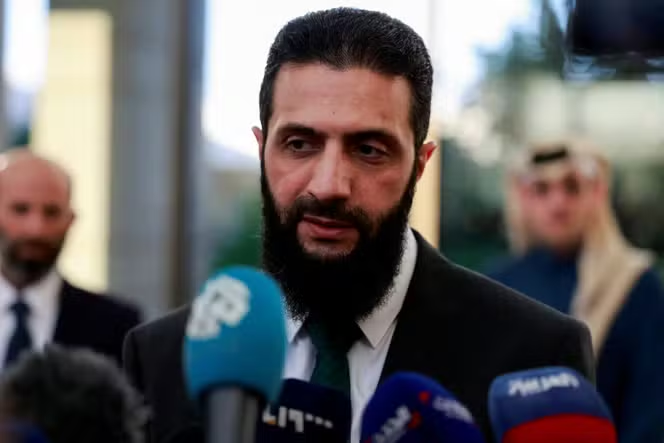
Syria’s political landscape has undergone a shift with the appointment of Ahmed al-Sharaa as the country’s interim president. The announcement was made on Wednesday by Syria’s new authorities, signaling the end of five decades of Bashar al-Assad family rule and the beginning of a transitional phase. Ahmed al-Sharaa, who leads the Islamist group Hayat Tahrir al-Sham (HTS), was tasked with forming a transitional government and overseeing the establishment of a new legislative body.
Ahmed al-Sharaa’s rise to the presidency follows a swift offensive by his rebel coalition, which successfully toppled Bashar al-Assad on December 8, 2024. The victory marked a major turning point in the Syrian civil war that has devastated the country since 2011. The transitional government that has been set up aims to lead Syria until March 1, 2025, with plans to steer the country towards a more stable and democratic future.
According to state media reports, Ahmed al-Sharaa’s appointment was confirmed by military official Hassan Abdel Ghani, who stated that Ahmed al-Sharaa would serve as the president in this crucial transitional period. Ghani also emphasized that Ahmed al-Sharaa would represent Syria at international forums, further underlining the shift in the country’s political dynamics.
Ahmed al-Sharaa’s first priority as interim president will be to form a “temporary legislative council” to govern Syria until a permanent constitution is established. State-run news agency SANA reported that the Bashar al-Assad-era parliament has been dissolved, and the country’s 2012 constitution suspended. The creation of a new legislative framework is expected to pave the way for a more representative government in Syria.
During a conference celebrating “the victory of the Syrian revolution,” which Ahmed al-Sharaa attended, Abdel Ghani announced the dissolution of the armed groups that played a role in Bashar al-Assad’s ouster, including the former regime’s army and security agencies. He further stated that all military factions, political bodies, and civil revolutionary organizations would be integrated into Syria’s state institutions, marking a significant step in the reorganization of the country’s governance.
The reshaping of Syria’s political structure also includes the dismantling of the Baath Party, which had ruled the country for decades. According to SANA, the party was officially dissolved as part of the broader efforts to rebuild Syria’s political institutions and establish a new national security framework. This will include the creation of a new security apparatus designed to protect citizens and ensure civil peace in the country.
In his speech at the conference, Ahmed al-Sharaa outlined his vision for Syria’s future. His priorities included filling the power vacuum left by the Bashar al-Assad regime, preserving civil peace, rebuilding state institutions, and developing a robust economy. Ahmed al-Sharaa acknowledged the immense responsibility placed upon his government, emphasizing the significance of their mission in rebuilding the nation.
Ahmed al-Sharaa also noted that it could take up to four years before national elections could be held and as long as three years to rewrite the country’s constitution. This timeline reflects the enormity of the task ahead and the challenges involved in re-establishing a functioning government after years of civil war.
While authorities had previously mentioned a national dialogue conference that would bring together Syrians from all political backgrounds, SANA did not provide any further details on such a conference following Ahmed al-Sharaa’s appointment. The ongoing civil war, which erupted in 2011 after Bashar al-Assad’s violent suppression of peaceful anti-government protests, has led to the deaths of over 500,000 people and the displacement of millions.
Hayat Tahrir al-Sham, the group led by Ahmed al-Sharaa, has its roots in Syria’s Al-Qaeda branch, and it remains classified as a terrorist organization by several governments, including the United States. However, the group has made efforts in recent years to moderate its rhetoric, claiming to protect Syria’s religious and ethnic minorities. The shift in leadership and the new interim government have raised hopes among Western diplomats for a more inclusive and stable future for Syria.
Since Bashar al-Assad’s removal, there has been a flurry of international diplomatic activity, with Western diplomats visiting Syria to encourage an inclusive political transition. Despite the challenges ahead, the appointment of Ahmed al-Sharaa as interim president represents a significant step toward a new chapter in Syria’s tumultuous history.