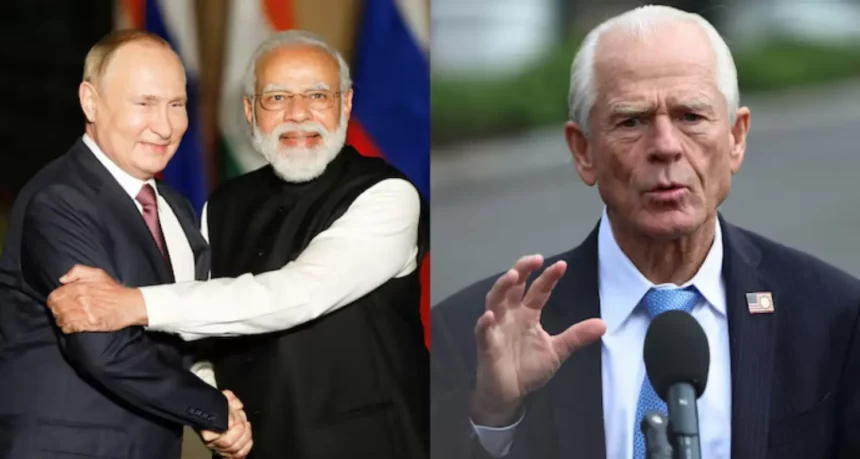
The political discourse between Washington and New Delhi has taken a sharp turn once again as Donald Trump’s close aide and former White House trade adviser Peter Navarro levelled stinging accusations against India, accusing the country of being a “laundromat for the Kremlin” over its oil trade with Russia. Peter Navarro’s comments, which follow his earlier description of India as the “Maharaja of tariffs,” highlight the intensifying friction in the Indo–US relationship as the Donald Trump administration prepares to double tariffs on Indian imports, citing both trade disputes and India’s increasing energy purchases from Russia. These remarks come at a moment when India is defending its sovereign right to diversify energy imports, even as Washington insists that New Delhi’s dealings with Moscow indirectly fund Russia’s war machine in Ukraine.
Peter Navarro’s Charges Against India Over Russian Oil Purchases
In his latest media appearance, Peter Navarro painted India as a central actor in prolonging Russia’s war against Ukraine, alleging that Indian refiners have become beneficiaries of discounted Russian crude while Moscow uses the revenue to finance its military campaign. According to Peter Navarro, India’s crude imports from Russia were “virtually negligible” before February 2022, but have since surged to nearly 30–35 percent of the country’s total oil intake. “The argument now, when this percentage has gone up to 30–35%, that somehow they need Russian oil, is nonsense,” Peter Navarro declared, suggesting that New Delhi’s energy diversification is more about opportunistic profit than genuine need.
In a clip shared by C-Span, Peter Navarro went further to argue that India, under Prime Minister Narendra Modi’s leadership, is not only enabling Russia’s war but also undermining global peace. “India doesn’t appear to want to recognise its role in the bloodshed… It’s cosying up to Xi Jinping. They don’t need the (Russian) oil,” Peter Navarro claimed, linking India’s trade policies with both Moscow and Beijing to what he sees as a strategic miscalculation. By framing India’s purchases as an act of complicity rather than necessity, Peter Navarro has attempted to portray New Delhi as an actor that willingly benefits from a global crisis while ignoring the humanitarian catastrophe unfolding in Ukraine.
He did, however, attempt to soften his criticism by adding a personal note of admiration for India’s leadership. “I love India. Modi is a great leader, but please, India, look at your role in the global economy. What you’re doing right now is not creating peace. It’s perpetuating the war,” Peter Navarro stated. Yet the balancing tone could not obscure the sharper sting of his accusations, which portrayed India as an opportunist undermining Western unity against Russia.
Peter Navarro also advanced a pointed critique of India’s refining practices, branding them as “a refining profiteering scheme.” According to him, discounted Russian oil is bought by India, processed by Indian refiners, and then re-exported to global markets, effectively laundering Moscow’s revenues through legitimate channels. “It’s a laundromat for the Kremlin,” he said, using a metaphor that immediately captured media attention and underscored his claim that India’s economic engagement with Russia indirectly fuels the Kremlin’s war chest.
These criticisms come just as Washington prepares to double down on punitive trade measures against India. Donald Trump’s earlier announcement of 25 percent tariffs on Indian imports has now escalated into a looming 50 percent tariff regime, with the first tranche already enforced and the second scheduled to take effect on August 27. Peter Navarro has been one of the most vocal defenders of this tariff strategy, repeatedly linking India’s oil purchases from Russia with what he perceives as unfair trade practices.
“In India, 25% tariffs were put in place because they cheat us on trade. Then 25% because of the Russian oil… They have higher tariffs, Maharaja tariffs,” Peter Navarro argued, reiterating his view that India has weaponized trade barriers while simultaneously profiting from discounted Russian crude. He emphasized that the United States suffers from a massive trade deficit with India, one that he believes hurts American businesses while indirectly financing Russia’s war.
The Donald Trump aide tied these two issues together by alleging that money earned by India through trade with the United States ultimately ends up in Moscow. “India pays the money it gets from doing business with the US, to Russia, for buying their oil, which then is processed by refiners, and they make a bunch of money there, but then the Russians use the money to build more arms and kill Ukrainians,” Peter Navarro said. He then connected this cycle to the burdens placed on the American taxpayer, who he argued is forced to finance Ukraine’s defense through military aid while Russia continues to be funded through trade networks. “That’s insane, and President Donald Trump sees that chessboard beautifully… In many ways, the road to peace runs through New Delhi,” Peter Navarro declared.
The comments reflect a familiar Peter Navarro pattern—harsh critiques of foreign nations paired with stark warnings of global consequences—all in service of Donald Trump’s broader protectionist and nationalist trade philosophy. Just days before, in an opinion piece for the Financial Times, Peter Navarro had described India’s Russian oil trade as “opportunistic” and “corrosive,” arguing that India’s refusal to curtail imports undermines Western unity and increases NATO’s vulnerability. “As Russia continues to hammer Ukraine, helped by India’s financial support, American (and European) taxpayers are then forced to spend tens of billions more to help Ukraine’s defence. Meanwhile, India keeps slamming the door on American exports through high tariffs and trade barriers. More than 300,000 soldiers and civilians have been killed, while NATO’s eastern flank grows more exposed and the West foots the bill for India’s oil laundering,” Peter Navarro wrote. His remarks serve as both a condemnation of India’s energy strategy and a justification for escalating tariffs.
India Pushes Back Against US Tariffs and Criticism
India, for its part, has not remained silent in the face of Peter Navarro’s escalating rhetoric and Donald Trump’s tariff measures. External Affairs Minister S. Jaishankar, currently visiting Moscow, issued a sharp rebuttal, describing Washington’s punitive tariffs as “perplexing” and “irrational.” S. Jaishankar reminded global audiences that India is not the largest buyer of Russian oil, nor the leading consumer of Russian LNG. “We are not the biggest purchasers of Russian oil, that is China. We are not the biggest purchasers of LNG, that is the European Union. We are not the country which has the biggest trade surge with Russia after 2022; I think there are some countries to the south,” S. Jaishankar said, pointedly deflecting attention toward China and certain European states.
By placing India’s purchases within a broader context, S. Jaishankar highlighted what New Delhi views as a double standard in Washington’s policies. While India is consistently targeted for criticism, major economies like China and the European Union continue their substantial engagement with Russia without facing comparable sanctions or tariffs. Indian officials argue that this selective targeting undermines Washington’s credibility and reveals the political motivations behind Donald Trump’s tariff regime.
New Delhi has also maintained that its energy strategy is shaped by pragmatic concerns, including ensuring affordable fuel for its population and securing its long-term energy independence. Officials stress that discounted Russian crude has allowed India to stabilize domestic prices at a time of global volatility, while also enabling refiners to strengthen their export competitiveness. In India’s view, this strategy is neither opportunistic nor corrosive, but rather a legitimate pursuit of national interest consistent with its independent foreign policy.
S. Jaishankar’s comments in Moscow also carried a broader geopolitical undertone, signaling that India does not intend to succumb to unilateral pressure from Washington. By asserting that other nations have much larger energy ties with Russia, the External Affairs Minister underscored India’s refusal to be scapegoated for the ongoing war in Ukraine. “We are perplexed at the rationale behind these tariffs,” S. Jaishankar said, reflecting India’s frustration at being targeted disproportionately compared to other global powers.
The friction over oil trade is only the latest flashpoint in a series of trade disputes between India and the United States under Donald Trump. Ever since the former president reignited his tariff offensive last month, bilateral trade ties have entered a period of heightened volatility. While Donald Trump and Peter Navarro have repeatedly castigated India for its “Maharaja tariffs,” New Delhi has defended its policies as consistent with World Trade Organization rules and reflective of India’s developmental priorities.
This simmering trade conflict comes against a backdrop of larger geopolitical realignments. As the war in Ukraine grinds on, Washington is under pressure to sustain NATO unity while also managing its own domestic political divisions. India, meanwhile, continues to pursue a foreign policy of strategic autonomy, balancing its partnerships with the United States, Russia, and other global actors. This balancing act inevitably produces friction, particularly when Washington expects alignment against Moscow while New Delhi insists on preserving its own space for maneuver.
Peter Navarro’s sharp rhetoric therefore encapsulates the tension at the heart of Indo–US relations in this moment. While praising India’s leadership and democratic values, Washington simultaneously accuses New Delhi of undermining global security through its energy choices. India, for its part, points to inconsistencies in US policies and emphasizes that it will not be dictated to in matters of energy security or foreign policy.
The coming weeks may prove pivotal. As the August 27 deadline for the second tranche of Donald Trump’s tariffs approaches, both sides will have to decide whether confrontation or accommodation will define the next chapter of their economic relationship. What is clear is that the rhetoric has already escalated sharply, with Peter Navarro’s labels—from “Maharaja of tariffs” to “laundromat for the Kremlin”—serving as symbolic markers of an increasingly fraught relationship between two of the world’s largest democracies.