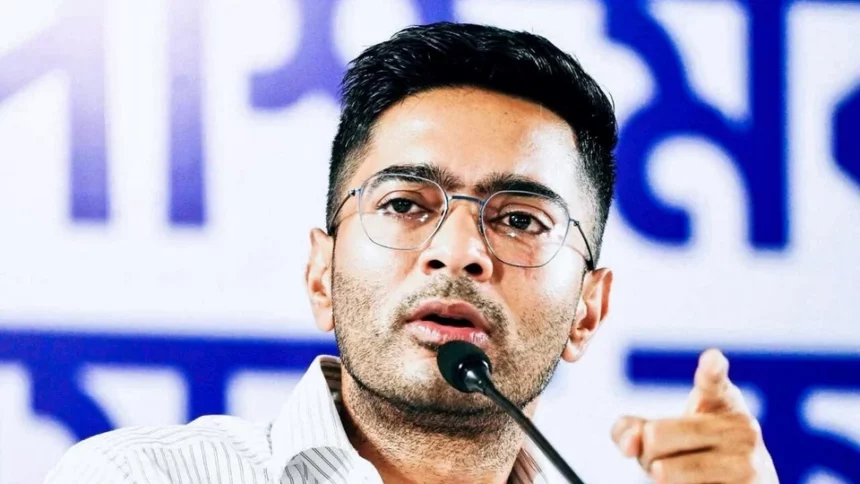
In a sharp escalation of political tensions in West Bengal, senior Trinamool Congress (TMC) leader Abhishek Banerjee launched a blistering attack on the Election Commission of India (ECI), accusing it of colluding with the Bharatiya Janata Party (BJP) to manipulate the voter list revision process ahead of the 2026 assembly elections. His remarks, made during a fiery press conference, have ignited a major controversy, with the BJP demanding that an FIR be filed against him for allegedly threatening the Chief Election Commissioner.
TMC’s Allegations of Bias and Electoral Manipulation
Abhishek Banerjee, the national general secretary of the TMC, alleged that the Election Commission, under the guise of conducting a Special Intensive Revision (SIR) of electoral rolls, was working in coordination with the BJP to exclude genuine voters from the lists in order to tilt the political balance in the saffron party’s favor ahead of the next assembly polls. His accusations came at a time when the West Bengal Chief Electoral Officer (CEO) convened an all-party meeting to discuss the details of the SIR process.
Banerjee’s statements reflected growing distrust between the ruling party in West Bengal and the Election Commission, which the TMC leader described as an “alliance organisation” of the BJP. He alleged that the exercise was being conducted to allow the government, rather than the people, to decide who would vote in the upcoming elections. “Our party’s stand is clear from day one,” Banerjee asserted. “This SIR’s motive is exclusion of voters. The government is now deciding who will vote. Earlier, voters decided who would govern.”
He went on to question the very legitimacy of the exercise, arguing that if the voter lists currently in use were indeed flawed, then the validity of the 2024 general elections must also come into question. “The existing voter lists were used during the Lok Sabha elections. If there is any fault in it, then dissolve Parliament and start over. From the Prime Minister to the Home Minister to me, all of us were elected through this list. We should all resign and then begin the SIR,” Banerjee said.
He further pointed out that in previous years, the process of voter list revision took significantly longer—“two years in 2002,” he noted—whereas the Election Commission now intends to complete it within just two months. This, he suggested, was another indication of the political intent behind the sudden acceleration of the process.
Another major contention raised by the TMC leader was the exclusion of Assam from the list of states undergoing the SIR. He questioned why the northeastern state, which also shares an international border and will go to polls alongside West Bengal, Kerala, Tamil Nadu, and Puducherry next year, was left out. “They have been clever to omit Assam because the BJP is in power there. How is it possible that other border states like Tripura and Meghalaya don’t have SIR, but Bengal does? If your motive is to deport illegal immigrants, then why not conduct the same exercise in other border states?” Banerjee said.
The TMC leader also made it clear that his party would not tolerate the deletion of genuine voters from the rolls. He vowed that if such an attempt was made, the TMC would take the fight to the national capital. “We will march to Delhi and gherao the Election Commission’s office. The TMC will not allow genuine voters to be deleted,” he warned.
Banerjee’s defiant tone was evident throughout the press conference as he challenged both the Election Commission and the BJP. “Come what may, we will increase our seats even after SIR, and the BJP will be below 50. Through this exercise, they are trying to bring a back-door NRC,” he declared.
Addressing Chief Election Commissioner Gyanesh Kumar directly, Banerjee issued a warning not to draw comparisons between West Bengal and other states. “The government will change, Mr. Gyanesh Kumar, then we will see,” he said, adding that the TMC would continue its campaign against what it described as a politically motivated revision process.
His repeated emphasis on the phrase “TMC will do what it has to” was seen by political observers as both a show of confidence and a signal of confrontation. Banerjee made it clear that his party was ready to take the matter beyond administrative protest, promising on-ground action if the EC failed to maintain neutrality.
BJP’s Counterattack and Demand for FIR Against Banerjee
The BJP wasted no time in responding to Abhishek Banerjee’s statements, accusing him of issuing “threats” to the Election Commission and the Chief Election Commissioner. Senior BJP leader Sukanta Majumdar condemned Banerjee’s remarks, calling them “dangerous for democracy” and demanded immediate legal action. He urged the Election Commission to file an FIR against Banerjee in New Delhi to ensure the safety of the Chief Election Commissioner.
“It should be noted how Abhishek Banerjee has threatened the Election Commission. For his own safety, the Chief Election Commissioner must register a complaint in Delhi. If anything untoward happens to him in the future, Banerjee should be held responsible,” Majumdar said in a video message.
Majumdar went on to describe Banerjee’s words as “goonda-style threats,” claiming that the TMC leader’s behavior exposed his disregard for constitutional principles. “This is what democracy is all about—fair elections and a transparent process. The Election Commission is doing its job by conducting the SIR. But Banerjee seems to be opposing it because he fears losing his illegal vote bank,” Majumdar said.
He also accused the TMC of defending “illegal voters,” alleging that Banerjee’s remarks indicated support for non-citizens. “Are you advocating voting rights for those who have entered from Bangladesh or the Rohingyas from Myanmar? These are not citizens of India. Aren’t you ashamed of yourself? Do you even understand the Constitution?” he asked rhetorically, adding that the TMC’s resistance to the revision exercise was rooted in political insecurity.
The BJP argued that the SIR was a routine exercise aimed at ensuring the accuracy of voter rolls and that similar processes were being carried out in other parts of the country. Majumdar emphasized that the TMC’s allegations of bias were baseless and politically motivated. “The process is about identifying genuine voters and removing duplicates or invalid entries. This is a constitutional mandate, not a political conspiracy,” he said.
According to the Election Commission’s recent announcement, the second phase of the SIR will be conducted in 12 states and union territories, including West Bengal, Kerala, Tamil Nadu, and Puducherry—all of which will go to polls in 2026. Other states like Goa, Gujarat, and Uttar Pradesh are scheduled for elections in 2027, and will also undergo voter list revisions as part of the broader nationwide exercise.
However, Banerjee’s allegations of selective targeting have found resonance within the TMC’s rank and file, who view the timing of the revision as an attempt to disrupt the state’s political equilibrium. TMC insiders have suggested that the exercise could lead to widespread voter deletions in districts perceived to be party strongholds.
Political analysts note that this confrontation between the TMC and BJP reflects a deepening polarization in West Bengal’s political landscape. For the ruling TMC, Banerjee’s rhetoric signals an early start to the 2026 campaign narrative—one built around defending democratic rights and regional pride against perceived central interference. For the BJP, however, the controversy provides an opportunity to project itself as a party defending the Constitution and the integrity of electoral processes.
The intensifying war of words underscores how electoral exercises, which are typically administrative in nature, have become politically charged battlegrounds in the run-up to elections. The TMC’s framing of the SIR as a “back-door NRC” mirrors the anxieties that fueled mass protests during the Citizenship Amendment Act (CAA) debate, while the BJP’s counter-narrative seeks to portray the TMC as a protector of illegal migrants and underminer of constitutional order.
As both parties prepare for the 2026 assembly polls, this episode is likely to become a defining flashpoint in their ongoing rivalry. With Banerjee doubling down on his allegations and the BJP pressing for criminal action, the stage appears set for yet another protracted political showdown in West Bengal—one that could shape the tone of electoral politics in the state for months to come.