

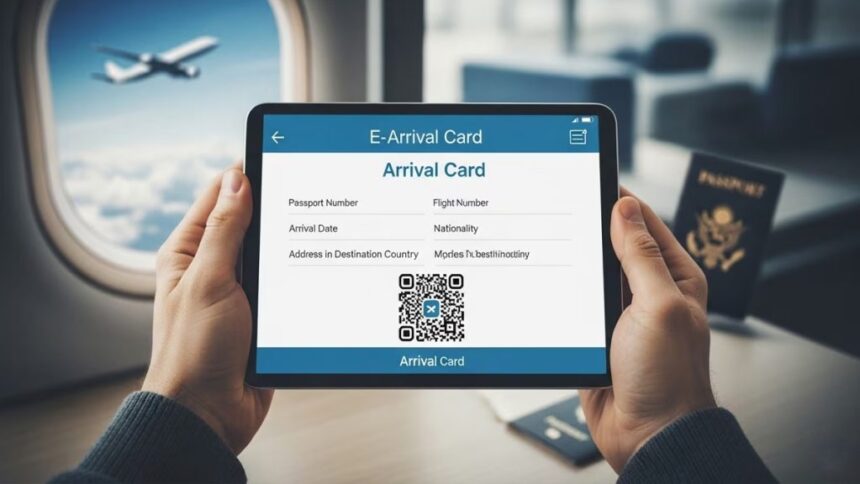
India introduces mandatory e-Arrival Card from April 1, 2026, requiring foreign travellers to submit digital entry details within 72 hours for faster and paperless immigration.
India has rolled out a major travel reform starting April 1, 2026, making it compulsory for foreign visitors to submit a digital e-Arrival Card before entering the country. The move replaces traditional paper-based arrival forms and marks a significant step towards modernising immigration processes across major airports.
The initiative, implemented by the Bureau of Immigration under the Government of India, aims to streamline entry procedures, reduce waiting time at airports, and enhance border security through digital tracking.
With this new system, travellers are expected to complete a short online form within 72 hours prior to arrival and present a QR code at immigration checkpoints for quicker processing.
What Is the e-Arrival Card and How It Works
The e-Arrival Card is essentially a digital replacement for the paper forms that passengers previously filled out during flights or at airport counters. It serves as a pre-arrival declaration system, allowing authorities to collect essential travel and identity information in advance.
Travellers can complete the form online using official platforms such as the Bureau of Immigration website, the Indian visa portal, or designated mobile applications. Once the form is submitted, a QR code is generated instantly.
This QR code acts as a digital pass that travellers must show to immigration officials upon arrival. The code is scanned, and the traveller’s details are retrieved immediately, significantly reducing processing time.
Authorities have indicated that early pilot testing of the system has resulted in a reduction of immigration waiting times by up to 40 percent at busy airports.
Who Needs to Fill the e-Arrival Card
The rule applies primarily to foreign nationals entering India, including tourists, students, business travellers, and other visitors. Additionally, Overseas Citizen of India (OCI) cardholders are also required to complete the form before arrival.
Indian citizens are exempt from this requirement, meaning they can continue to travel without filling out the e-Arrival Card.
For families and groups travelling together, the system offers a convenient feature—one individual can submit details for up to five members in a single form. This reduces duplication and simplifies the process for group travellers.
Timeline and Submission Window
The e-Arrival Card must be submitted within a specific time frame—no earlier than 72 hours before arrival and ideally before boarding the flight.
This timeline ensures that the information provided remains current and relevant while allowing authorities sufficient time to process and verify the data.
Travellers are advised to complete the process well in advance to avoid last-minute complications, especially during peak travel seasons.
Information Required for Submission
The form has been designed to be simple and quick, requiring only basic details. Travellers do not need to upload documents or provide scanned copies of identification.
Key information required includes passport details such as number, issue date, and expiry date, along with flight information including flight number, arrival date, and destination airport.
In addition, travellers must provide contact details such as phone number and email address, specify the purpose of their visit, and mention their accommodation details in India.
The entire process typically takes less than five minutes to complete, making it accessible even for first-time users.
Submission Platforms and Accessibility
The government has ensured that the e-Arrival Card can be submitted through multiple official channels, providing flexibility for travellers.
These include the Bureau of Immigration’s official website, the Indian visa portal, and mobile applications such as Su-Swagatam. All platforms are free to use and designed with user-friendly interfaces.
Travellers can access these platforms using smartphones, tablets, or computers, making the process convenient regardless of location.
It is recommended that travellers download or screenshot the QR code after submission and keep a backup copy, either digitally or in print, to avoid any issues at the airport.
What Happens If You Don’t Fill It
While the e-Arrival Card is mandatory, authorities have clarified that travellers will not be denied entry if they fail to complete the form. However, skipping the process can lead to delays and additional scrutiny at immigration checkpoints.
Passengers who arrive without the QR code may be required to undergo manual verification, which can significantly increase waiting time and cause inconvenience.
Airlines are also expected to remind passengers about the requirement, and in some cases, they may encourage travellers to complete the form before boarding.
Why India Introduced the Digital System
The introduction of the e-Arrival Card is part of India’s broader effort to modernise its border management systems and align with global best practices followed by countries such as Singapore, Australia, and the United Arab Emirates.
Traditional paper forms often led to inefficiencies, including long queues, incomplete information, and administrative delays. By shifting to a digital system, the government aims to improve efficiency, accuracy, and security.
The system also enables better tracking of incoming travellers, helping authorities identify potential risks and ensure compliance with immigration regulations.
In addition to operational benefits, the move supports environmental sustainability by reducing paper usage and waste.
Impact on Major Airports
The new system is expected to have the most significant impact at major international airports such as Delhi, Mumbai, Bengaluru, and Hyderabad, where high passenger volumes often lead to congestion.
By digitising the arrival process, authorities aim to streamline passenger flow and reduce bottlenecks at immigration counters.
The introduction of QR code-based verification allows for faster processing, enabling officers to focus on security checks rather than manual data entry.
Over time, the system is expected to integrate with advanced technologies such as facial recognition and automated e-gates, further enhancing efficiency.
Transition Period and Backup Options
During the initial rollout phase, the government has indicated that limited backup options may be available for travellers who are unable to complete the digital form.
However, this transitional flexibility is expected to be phased out as the system stabilises and adoption increases.
Travellers are strongly encouraged to switch to the digital process as early as possible to avoid inconvenience and ensure a smooth travel experience.
Broader Implications for Travel and Tourism
The introduction of the e-Arrival Card is likely to have a positive impact on India’s tourism sector by improving the overall travel experience for international visitors.
Faster immigration clearance can enhance first impressions and encourage repeat visits, contributing to the growth of tourism and related industries.
For business travellers, the streamlined process reduces time spent at airports, allowing for more efficient travel schedules.
The move also positions India as a technologically advanced destination, aligning with global standards in travel and border management.
Challenges and Preparedness
Despite its advantages, the new system may face initial challenges, particularly in terms of awareness and adoption among travellers.
Ensuring that visitors are informed about the requirement before arrival is crucial for the success of the initiative.
Airlines, travel agencies, and online booking platforms are expected to play a key role in spreading awareness and guiding travellers through the process.
The government has also focused on making the system intuitive and accessible to minimise errors and improve user experience.
A Step Towards Digital Governance
The e-Arrival Card represents a significant step in India’s journey towards digital governance and smart infrastructure.
By leveraging technology, the government aims to create a more efficient, transparent, and secure immigration system.
This initiative is part of a broader push to integrate digital solutions across various sectors, enhancing service delivery and improving citizen and traveller experiences.
Looking Ahead
As the new rule comes into effect from April 1, 2026, travellers planning to visit India must familiarise themselves with the e-Arrival Card requirement and ensure timely submission.
The transition to a fully digital system marks a major milestone in India’s efforts to modernise its travel infrastructure.
With faster processing, reduced paperwork, and improved efficiency, the e-Arrival Card is expected to significantly enhance the arrival experience for foreign visitors.