

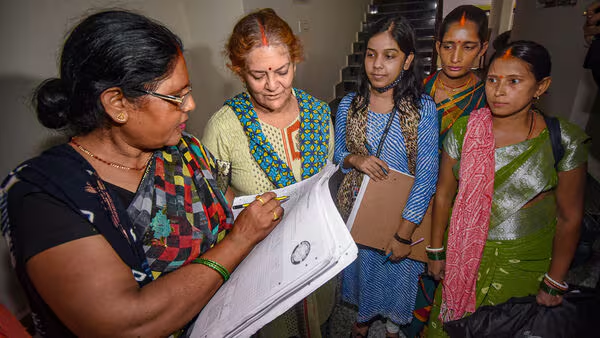
The government has issued 33 FAQs for the upcoming Census, clarifying key guidelines including treating stable live-in couples as married households during enumeration.
The Government of India has released a detailed set of 33 Frequently Asked Questions (FAQs) to guide citizens through the first phase of the country’s 16th Census, aiming to simplify participation and improve accuracy in data collection. The FAQs, made available on the official self-enumeration portal, address a wide range of queries, including household definitions, family structures, and the process of filling out census forms.
One of the most notable clarifications in the FAQ document is the recognition of live-in relationships. According to the guidelines, if a couple in a live-in arrangement considers their relationship to be stable, they may be treated as a married couple for census purposes. This marks a significant step in adapting census practices to reflect evolving social realities in India.
The Census, conducted under the supervision of the Registrar General of India, is one of the largest administrative exercises in the world. It plays a crucial role in shaping public policy, resource allocation, and governance by providing comprehensive demographic data.
Simplifying the Census Process Through FAQs
The introduction of 33 FAQs is part of the government’s broader effort to make the census process more transparent and user-friendly. These FAQs aim to address common concerns that citizens may have while participating in the enumeration process, particularly as digital self-enumeration becomes more prominent.
The self-enumeration portal allows individuals and households to submit their details online, reducing the need for manual data collection and increasing efficiency. However, the shift towards digital participation also requires clear guidance to ensure that citizens understand how to accurately provide information.
The FAQs cover various aspects of the census, including how to define a household, how to record relationships between members, and what details are required for each individual. They also provide clarity on handling special situations, such as temporary residents, migrants, and shared accommodations.
By addressing these issues in advance, the government aims to minimise errors and ensure that the data collected is both accurate and comprehensive.
Recognition of Changing Social Structures
One of the most discussed aspects of the FAQs is the inclusion of guidelines for live-in relationships. Traditionally, census data has been based on conventional definitions of family and marriage. However, with changing societal norms, there is a growing need to recognise diverse forms of relationships.
The decision to treat stable live-in couples as married units reflects this shift. It acknowledges that such relationships, when considered stable by the individuals involved, function similarly to marriages in terms of shared living arrangements and responsibilities.
This move is likely to improve the accuracy of demographic data by capturing a broader range of household structures. It also aligns with evolving legal and social perspectives on relationships in India.
Experts believe that this recognition will provide a more realistic picture of society, helping policymakers design inclusive policies that cater to diverse family arrangements.
Importance of Accurate Data Collection
The Census is a critical tool for governance, influencing decisions across sectors such as healthcare, education, housing, and employment. Accurate data is essential for identifying population trends, assessing resource needs, and planning development initiatives.
The FAQs emphasise the importance of providing correct and complete information. Citizens are encouraged to answer all questions truthfully and ensure that details such as age, gender, occupation, and education level are accurately recorded.
The inclusion of detailed instructions is expected to reduce confusion and improve participation rates. With millions of households involved, even small errors can have a significant impact on overall data quality.
The government has also highlighted the confidentiality of census data, assuring citizens that their personal information will be used solely for statistical purposes and will not be shared with other agencies.
Digital Transformation of the Census
The upcoming Census marks a significant step towards digital transformation. The introduction of a self-enumeration portal allows citizens to participate in the process from the comfort of their homes.
This approach offers several advantages, including faster data collection, reduced logistical challenges, and improved accuracy through automated validation checks. It also enables real-time monitoring of progress, helping authorities identify and address gaps in coverage.
However, the transition to digital methods also presents challenges, particularly in regions with limited internet access or digital literacy. To address this, the government has ensured that traditional enumeration methods will continue alongside digital options.
Enumerators will visit households to assist those who are unable to complete the process online, ensuring that no section of the population is left out.
Addressing Common Concerns
The FAQs provide clarity on several practical issues that citizens may encounter during the census process. For instance, they explain how to count individuals who are temporarily away from home, such as students or migrant workers.
Guidelines are also provided for households with multiple families living under one roof, helping ensure that each unit is recorded correctly. In cases where individuals are unsure about certain details, the FAQs offer step-by-step instructions to guide them.
Another important aspect covered is the definition of a “usual resident.” This term refers to individuals who have lived in a particular location for a specified period or intend to stay there. Understanding this definition is crucial for accurate enumeration.
By addressing these and other questions, the FAQs aim to eliminate ambiguity and make the process smoother for participants.
Pre-Test Exercises and Preparations
Ahead of the full-scale Census, authorities have been conducting pre-test exercises in selected areas to evaluate the effectiveness of the new systems and methodologies. These exercises help identify potential issues and refine processes before nationwide implementation.
For example, trial runs in districts like Bulandshahr in Uttar Pradesh have provided valuable insights into the functioning of the self-enumeration portal and the challenges faced by enumerators and citizens.
Such preparatory measures are essential for ensuring that the Census is conducted efficiently and without major disruptions.
Policy Implications and Future Impact
The data collected during the Census will have far-reaching implications for policy-making and governance. It will inform decisions on infrastructure development, social welfare programmes, and economic planning.
The inclusion of updated definitions and guidelines, such as those for live-in relationships, ensures that the data reflects current societal realities. This, in turn, enables more effective and inclusive policy formulation.
For instance, understanding the composition of households can help design housing schemes, while data on education and employment can guide skill development initiatives.
The Census also plays a key role in determining the allocation of resources to states and regions, making its accuracy and reliability crucial.
Public Participation and Awareness
The success of the Census depends largely on public participation. The government has been actively promoting awareness about the importance of the exercise and encouraging citizens to cooperate fully.
Campaigns highlighting the benefits of accurate data and the ease of participation through digital platforms are expected to boost engagement. The FAQs serve as an important tool in this effort, providing clear and accessible information to the public.
Citizens are urged to take the process seriously and provide honest responses, as the data collected will shape the country’s development for years to come.
The release of 33 FAQs for the 16th Census represents a proactive step by the government to simplify the enumeration process and address common concerns. By providing clear guidelines and recognising evolving social structures, the initiative aims to ensure accurate and inclusive data collection.
The inclusion of provisions for live-in couples highlights the Census’s adaptability to changing societal norms, while the emphasis on digital participation reflects a move towards modernisation.
As the country prepares for this massive exercise, the focus remains on accuracy, inclusiveness, and public cooperation. The success of the Census will not only provide a snapshot of India’s demographic landscape but also lay the foundation for informed decision-making and sustainable development in the years ahead.