

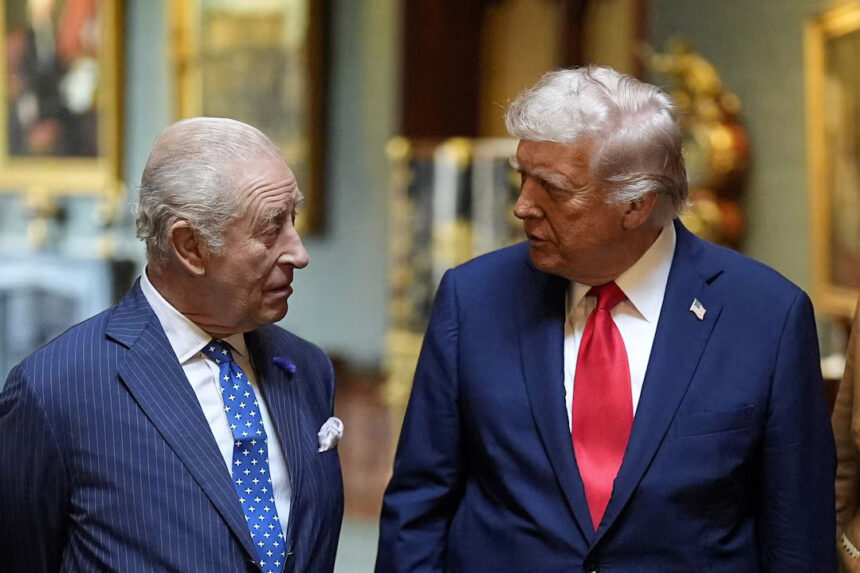
A White House caption calling Donald Trump and King Charles “Two Kings” ignites political debate over symbolism, democracy, and executive power during a high-profile state visit.
The recent meeting between Donald Trump and King Charles III at the White House has stirred a wave of political commentary, public debate, and media scrutiny, not only in the United States but also across the United Kingdom and beyond. What might have otherwise been a routine diplomatic engagement took on a symbolic dimension after the White House shared a photograph of the two leaders with the caption “TWO KINGS.” The phrase, brief yet loaded, triggered immediate reactions from political leaders, historians, analysts, and citizens, raising questions about democratic values, political imagery, and the nature of executive power in modern governance.
At the heart of the controversy lies the contrast between two fundamentally different political systems. The United States was founded in direct opposition to monarchy, born out of a revolution against British rule in the late 18th century. The Declaration of Independence explicitly condemned King George III, accusing him of tyranny and abuse of power. In contrast, the United Kingdom continues to maintain a constitutional monarchy, where the sovereign plays a largely ceremonial role while elected officials govern. The juxtaposition of a democratically elected president with a hereditary monarch under the label “Two Kings” therefore carries deep historical and ideological implications.
During the official welcome ceremony, Trump reflected on the enduring relationship between the United States and the United Kingdom, describing it as an “Anglo-American revolution in human freedom” that has stood the test of time. His remarks attempted to frame the meeting as a celebration of shared values rather than a contradiction of political systems. Yet the symbolic weight of the “Two Kings” caption overshadowed the intended message, becoming the focal point of public discourse.
Critics were quick to respond. Representative Joe Morelle, a Democratic lawmaker from New York, emphasized the fundamental principle that in the United States, sovereignty rests with the people, not a single individual. His remarks highlighted a concern that the imagery could blur the distinction between democratic leadership and authoritarian symbolism. For many observers, the issue was not merely about a caption but about a broader pattern of rhetoric and imagery associated with Trump’s political style.
This is not the first time Trump has been linked to monarchical or authoritarian imagery. In October 2025, he shared AI-generated videos depicting himself wearing a crown and royal attire, portraying exaggerated scenarios in which political opponents appeared submissive. These posts drew criticism from opponents who argued that such imagery undermines democratic norms and fosters a cult of personality. Supporters, however, dismissed the concerns as overreactions, interpreting the content as satire or political messaging designed to energize his base.
The timing of the White House caption added another layer of complexity. The meeting occurred shortly after a reported assassination attempt on Trump, which had already heightened political tensions and public attention. In an interview with CBS’s “60 Minutes,” Trump addressed accusations of king-like behavior with a mix of humor and deflection, stating, “I’m not a king. If I was a king, I wouldn’t be dealing with you.” The remark was widely circulated, interpreted by some as a dismissal of criticism and by others as an acknowledgment of the ongoing debate.
Meanwhile, King Charles III’s presence brought its own historical resonance. In his address to Congress, he invoked foundational documents such as the Magna Carta, the British Declaration of Rights of 1689, and the U.S. Bill of Rights of 1791. His emphasis on checks and balances served as a reminder that even within a monarchy, the concentration of power is constrained by legal and institutional frameworks. His speech was widely praised for its diplomatic tone and its focus on shared democratic principles.
The state visit itself was intended to reinforce the longstanding alliance between the United States and the United Kingdom. The two nations share deep ties in areas such as defense, trade, intelligence cooperation, and cultural exchange. From NATO partnerships to economic agreements, their relationship is often described as a “special relationship,” rooted in common language, history, and political ideals. The meeting between Trump and Charles was meant to symbolize continuity and cooperation, particularly at a time of global uncertainty.
However, the controversy surrounding the “Two Kings” remark illustrates how symbolism can shape political narratives. In the age of social media, a single phrase or image can quickly overshadow substantive discussions, becoming a focal point for broader debates about leadership, identity, and governance. The rapid spread of the caption across platforms like Twitter amplified its impact, drawing reactions from across the political spectrum.
Supporters of Trump argued that the criticism was exaggerated and politically motivated. They contended that the caption was intended as a lighthearted acknowledgment of two prominent figures rather than a serious statement about governance. For them, the outrage reflected a tendency among critics to interpret Trump’s actions in the most negative light possible.
On the other hand, critics viewed the incident as part of a larger pattern that raises legitimate concerns about the normalization of authoritarian imagery in democratic contexts. They argued that even symbolic gestures can influence public perception and political culture, particularly when they come from the highest levels of government.
The debate also touches on broader questions about the role of political communication in the modern era. Leaders today operate in an environment where messaging is instantaneous, global, and often subject to multiple interpretations. The line between humor, symbolism, and serious political signaling can be difficult to discern, making it essential for public figures to consider the potential implications of their words and actions.
Historically, the United States has been vigilant about avoiding any association with monarchy. The Constitution explicitly prohibits titles of nobility, reflecting the founders’ determination to create a system based on equality and representation. Against this backdrop, the “Two Kings” remark stands out as particularly provocative, even if unintended.
At the same time, the incident highlights the enduring fascination with power and leadership. The imagery of kings and crowns carries a certain cultural resonance, evoking ideas of authority, tradition, and grandeur. In a media-driven world, such imagery can be both आकर्षक and controversial, depending on the context in which it is used.
As the state visit concluded with a formal dinner attended by political leaders, diplomats, and dignitaries, the focus gradually shifted back to policy discussions and diplomatic engagement. Yet the controversy surrounding the caption continues to linger, serving as a reminder of the complex interplay between symbolism and politics.
Ultimately, the meeting between Donald Trump and King Charles III underscores the importance of understanding the historical and ideological foundations of governance. While the United States and the United Kingdom share many common values, their political systems are fundamentally different. Recognizing and respecting these differences is essential for maintaining a healthy and productive relationship.
The “Two Kings” remark may fade from headlines over time, but the questions it raises about leadership, symbolism, and democratic principles are likely to remain relevant. In an era where perception often shapes reality, even a single phrase can spark a conversation that extends far beyond its original context.